FileHousing
Handed a Roof Survey and No One to Explain It? How to Read It Alone, Ten Years On
A decade ago a roof survey was two pages and a phone call. Now it is forty photos and a dated proposal, and the reading order has changed with it.
- BySylvia Achterberg
- Cut11/19/26
- Length1,164 words
- Read5 min
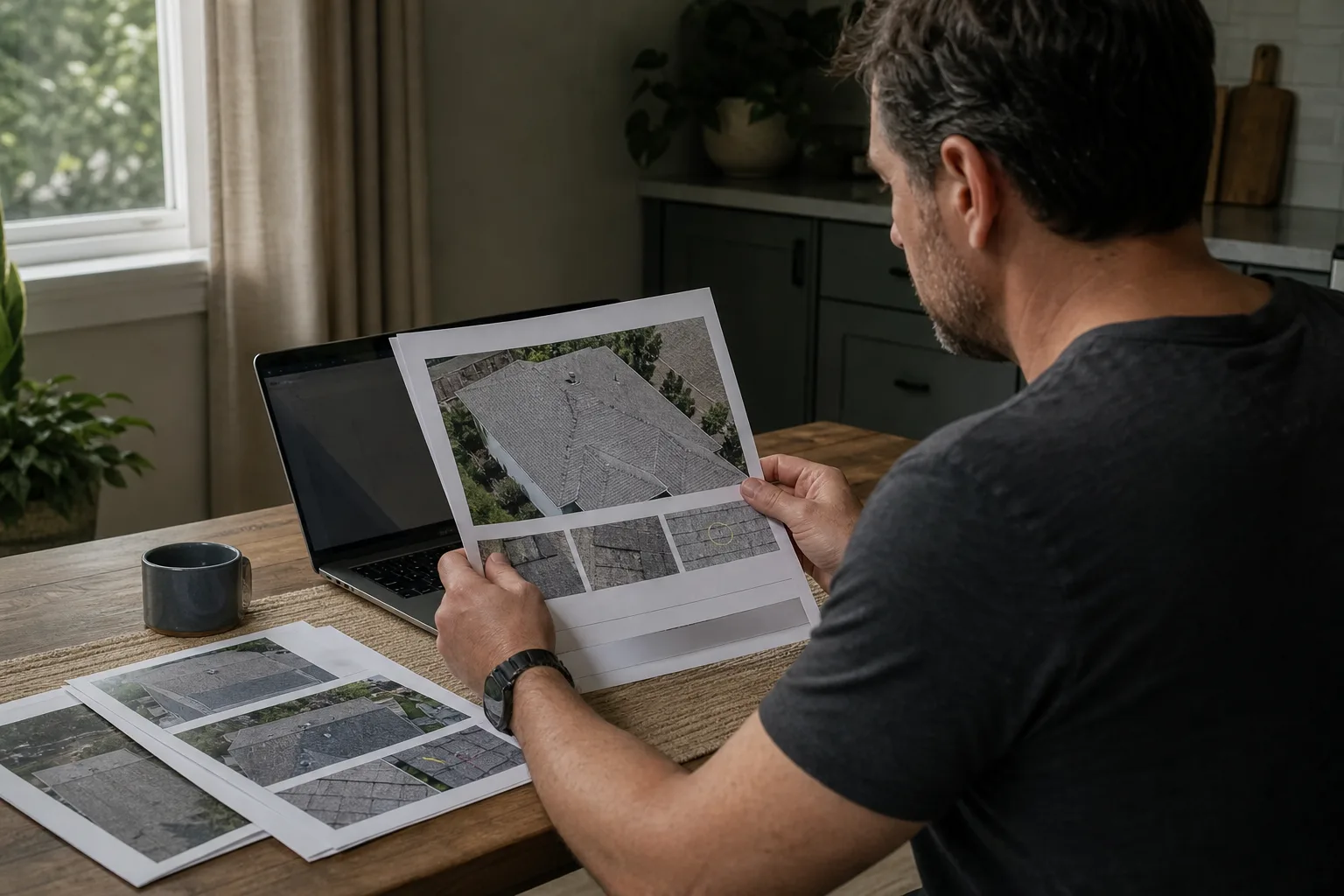
Ten years ago, a homeowner who asked for a roof inspection usually got a single sheet. A few handwritten lines, a total, and a signature block at the bottom. If you wanted to understand it, you asked the man who wrote it, and he told you over the phone while standing in someone else's driveway. The document was not really the product. The conversation was.
That has changed, and mostly in the homeowner's favor. A current survey from an established roofing company tends to arrive as a PDF with drone or pole-camera imagery, a slope-by-slope condition table, measured squares, and a proposal with a stated expiration date. You can read it at your kitchen table on a Tuesday night with nobody waiting on your answer. But the reading takes a different skill than it used to, and the dates inside it now carry weight that the old one-page estimate never did.
What the document used to be, and what it is now
The older survey was a summary of a judgment already made. Someone climbed up, looked, came down, and told you what he thought. You could not verify any of it without a second climb, which meant a second company, which meant a second appointment. Comparing two opinions took a week and a lot of phone tag.
The current document is closer to evidence plus an interpretation. The photographs are the evidence. The condition narrative is the interpretation. Those two things can be read separately, which is the whole reason you can now get value out of a survey without anyone standing next to you.
Practically, that means a modern survey usually includes some combination of:
- Imagery indexed to a slope or elevation, so a photo labeled "north slope, field" can be found again later.
- Measurements in squares, with waste percentage sometimes stated and sometimes buried.
- A condition list separating active failure from aging.
- A scope of work with line items, which may or may not match the condition list item for item.
- A price with a validity window and, in many cases, a note about material price adjustments.
The mismatch between the third and fourth bullets is where most of the useful reading happens.
Three ways to read it alone, compared
Read it yourself against the photographs
This is free and it is more effective than it was in 2015, because the photographs exist. The method is mechanical: take every line item in the scope of work and find the photograph that justifies it. Decking replacement should have a photo of compromised decking or a note that the condition is concealed until tear-off. Flashing replacement should have a photo of the flashing in question. If a line item has no corresponding image and no explanation, that is a question, not an accusation. Write it down.
Then run it in reverse. Every condition noted in the narrative should appear somewhere in the scope or be explicitly deferred. A survey that flags saturated insulation and then does not price its removal is incomplete, and that gap will surface later as a change order.
What this approach cannot do is tell you whether a roof has five years left or fifteen. That is a judgment call and photographs do not make it for you.
Pay an independent inspector
A decade ago, a paid roof inspection that came with no bid attached was an unusual request in most residential markets. It is now a normal line of business, and the fee is typically a few hundred dollars for a report that does not end in a sales proposal. For a full replacement decision, that fee is small relative to what is at stake.
The comparison worth making is this: an independent report gives you a second judgment, but it costs money and adds a week or two to your timeline. A careful self-read costs an evening and gives you better questions rather than better answers. Homeowners facing a repair tend to be well served by the self-read. Homeowners facing a full tear-off, especially one that may be partly covered by insurance, tend to be well served by the paid second opinion.
Use the insurer or the manufacturer as a third reader
If the damage is storm-related, your insurer's adjuster is already going to read the roof, and their report becomes a document you can set beside the contractor's. Where the two disagree, the disagreement itself is informative. Manufacturers also publish installation and ventilation requirements for their shingle systems, and a scope that does not meet them can put a material warranty at risk. That is a thing you can check without anyone's help, and it did not used to be easy.
The dates, and what each one triggers
This is the part that has changed most and gets the least attention. The old handwritten estimate rarely expired in writing. Current proposals usually do.
- Proposal expiration. Commonly stated as a number of days from issue. After it lapses, the price is not binding and material costs are typically re-quoted. Note the date on the first page, not the day you got around to opening the email.
- Right to cancel. For contracts signed at your home rather than at a place of business, federal rules administered by the Federal Trade Commission give consumers a short cancellation window on many door-to-door sales, and some states add their own protections for post-storm repair contracts. The window runs from signing, and it runs whether or not you have finished reading.
- Insurance notice and proof of loss. Policies set deadlines for reporting damage and for submitting documentation. These are triggered by the date of loss, not the date you noticed the ceiling stain.
- Permit validity. Where a permit is pulled, it has its own expiration and inspection milestones, which matter if the job is phased.
A survey read two weeks late is still useful. A proposal read two weeks late may need to be reissued at a different number.
Why coastal location changes the reading
Along the Southern California coast, salt air and marine layer moisture do things to fasteners, flashing and underlayment that an inland survey will not emphasize. When you read a report on a house within a few miles of the water, pay attention to what it says about fastener corrosion, flashing metal specification and ventilation. A firm that handles roofing in long beach regularly will usually call these out by name, and their presence in the narrative is a reasonable sign the inspection was specific to your house rather than generic.
Low-slope and flat sections, common on the older stock in these neighborhoods, deserve their own paragraph in any survey. If the report treats a flat section with the same language as a pitched one, ask about it.
Set a calendar reminder three days before the proposal expires. Read the survey twice before then: once for the photographs, once for the dates. The questions you write down on the second pass are the ones worth a phone call.