FileHousing
Reading an Inspection Report? The Party It Was Written to Protect Never Signs It
Home inspection reports are drafted with an errors and omissions insurer reading over the inspector's shoulder, which explains the hedging and tells you where to look.
- ByDesmond Falk
- Cut10/6/26
- Length997 words
- Read4 min
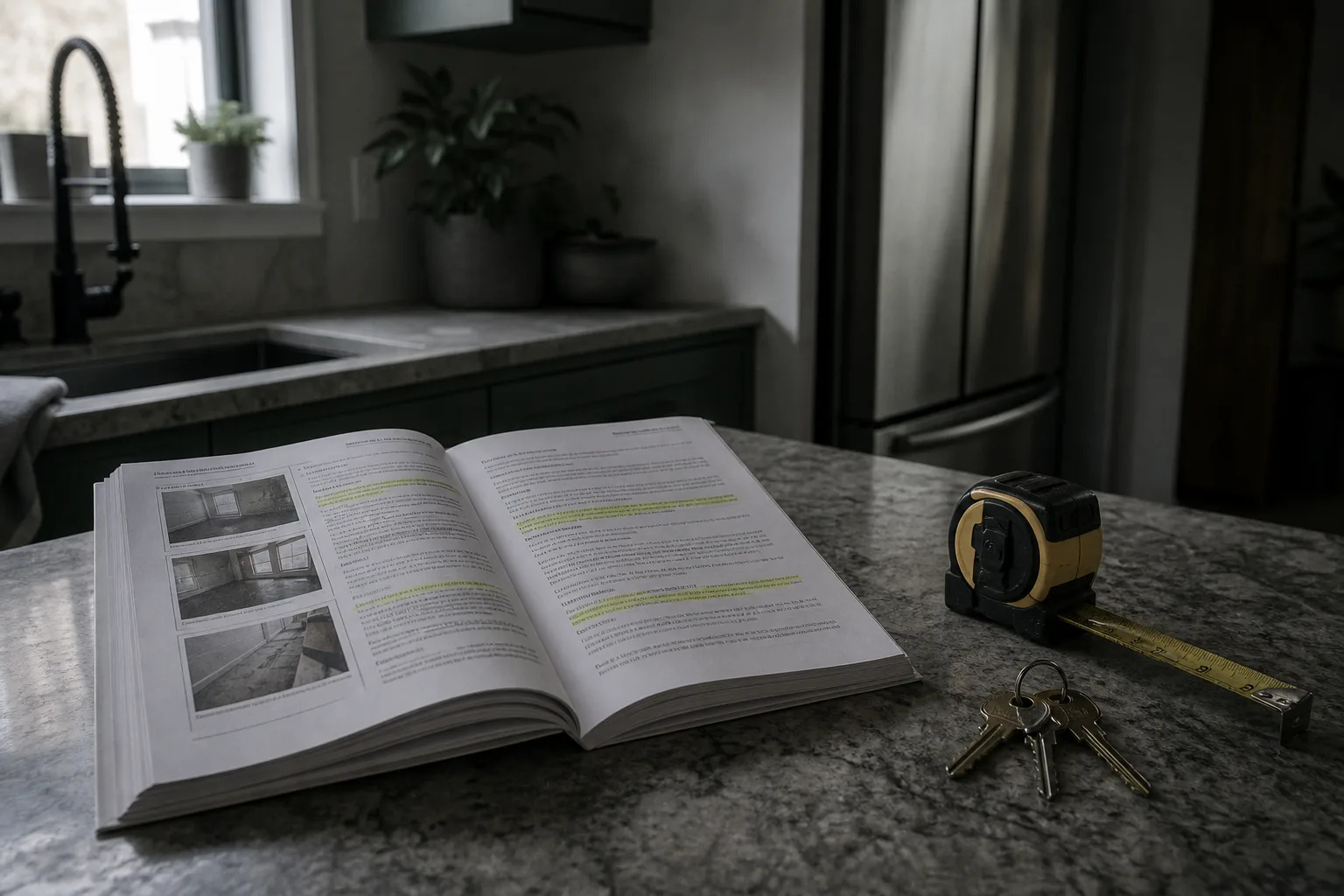
Open a residential inspection report and count the qualifiers. "Appeared serviceable at the time of inspection." "Recommend further evaluation by a licensed specialist." "Not inspected: no safe access." Buyers read this as hedging, and it is. But it is not vague by accident or by laziness. The report is a legal document drafted under the eye of a party who never appears in the transaction, never signs anything, and never gets introduced: the inspector's errors and omissions carrier.
Once you know that reader exists, the document becomes much easier to use. The hedges stop looking like evasion and start looking like a map of where the inspector's exposure sits, which is usually also where your money sits.
The third party in a two-party deal
You hire the inspector. The inspector reports to you. That is the whole relationship as most buyers understand it. In practice the inspector is also writing for a claims file that may be opened two years from now by a homeowner who found a cracked heat exchanger and wants someone to pay for it.
Professional liability coverage for home inspectors is not cheap relative to the fee, and carriers underwrite it by looking at the inspector's report template, their contract, and their complaint history. An inspector who writes flat declarative statements about systems they cannot fully see is a worse risk than one who writes conditional statements tied to what was visible on the day. The language in your report reflects that pressure. It is the carrier's voice, filtered through the inspector's keyboard.
This is worth knowing because it tells you what the report is not. It is not a warranty, not a code compliance review, and not a prediction. It is a record of observable condition on a single morning, written so that it can be defended line by line.
How the standard paragraph became standard
Residential inspection grew up as a trade before it was a licensed profession in most states. Through the 1970s and 1980s there was no agreed scope, which meant two inspectors could look at the same house and produce documents with nothing in common. Trade associations wrote standards of practice to fix that, and those standards did two things at once. They told inspectors what they had to look at. They also told inspectors, in equal detail, what they were not obliged to look at.
State licensing arrived later and in most cases adopted an association standard by reference, or wrote something close to it. The exclusion lists carried over intact. So the sentence in your report about not entering a crawlspace with less than a certain clearance is usually not the inspector's personal preference. It is lifted from the standard that licensed them, which was in turn shaped by a couple of decades of claims experience.
Roofs are the clearest example. The Occupational Safety and Health Administration is responsible for fall protection requirements for people working at height, and an inspector weighing whether to walk a wet, steeply pitched slate roof is weighing a fall against a fee. The standards resolved that by making roof walking optional and roof reporting mandatory from whatever vantage point is available. That is why reports so often say the roof was observed from the ground or from a ladder at the eave.
Reading the exclusions as a cost forecast
Treat every "not inspected" and "further evaluation recommended" as an open item with a dollar figure attached that nobody has calculated yet. Three categories matter most for what the house costs you to run:
- Not accessible. The area exists and was not seen. Attic space behind storage, the back slope of the roof, the portion of the foundation behind finished basement walls. These are not absolutions; they are gaps.
- Beyond scope. Buried oil tanks, septic interiors, wells, detached outbuildings, swimming pool structures. Each typically needs a separate specialist and a separate fee.
- Age noted without condition stated. A twenty-two year old furnace that "operated when tested" is a replacement you will likely fund within a few years.
The running cost of a house is almost always the larger number over a decade of ownership, and the exclusion list is the closest thing to an advance schedule of it that you will get before closing.
Where aerial inspection moved the line
The access exclusions were written when the only ways to see a roof were a ladder, a pair of binoculars, and nerve. That constraint has loosened. Specialized drone surveying services now produce documented overhead imagery of slopes, flashings, chimney crowns, and gutter lines that an inspector would previously have reported as unobserved, and the imagery is timestamped, which matters later if a hail or wind claim turns on when damage appeared.
For a buyer, the practical move is to ask before the inspection whether aerial coverage is included or available as an add-on, and to ask what the output looks like. A folder of high-resolution stills tied to specific elevations is worth considerably more than a short flyover video. On a tall house, a complex roof, or anything with multiple intersecting planes, it converts the single largest exclusion in a typical report into something you can actually price.
Using the report after you own the house
Keep it. Most buyers file the inspection with the closing packet and never open it again, which wastes the most useful part of the document. The conditional language that frustrated you in week one becomes a baseline in year four: what the roof looked like then, what the panel was rated at, which drain lines were already sluggish. When you file a claim or sell, that baseline does real work.
The hedging in your report is the visible edge of a long argument between inspectors, standards bodies, and the insurers behind them about what one person can responsibly promise after four hours in a stranger's house. Read it as the result of that argument and it will tell you, fairly precisely, where to spend next.