FileLegal
Keeping Receipts in a Drawer? How the Rules Decided What Counts as Proof
Household disputes turn less on who is right than on which records survive scrutiny, and the standards for that came from somewhere specific.
- BySylvia Achterberg
- Cut11/6/26
- Length1,069 words
- Read5 min
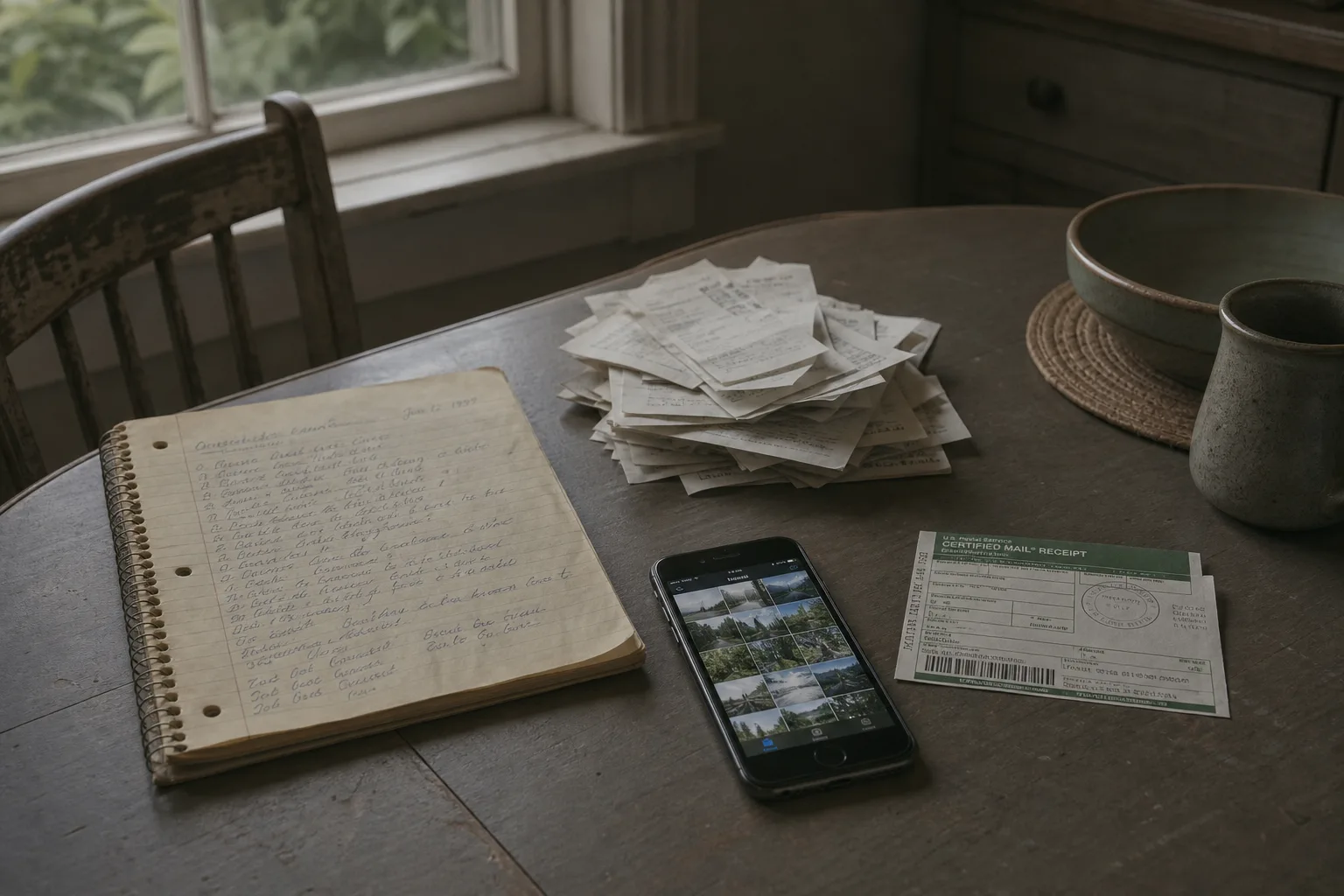
A homeowner with a clear memory of a conversation and a contractor with a different memory of the same conversation are, for practical purposes, even. Neither has anything that an adjuster, a mediator or a small claims judge can weigh. The party who wrote something down that week, and can show when it was written, is not even. That asymmetry is not an accident of modern practice. It is the residue of a long argument about which records can be trusted when the person who made them is not available, or is available and highly motivated.
The habit households borrowed from commerce
The general rule against hearsay keeps out-of-court statements from being used to prove what they assert. If that rule had no exceptions, almost no paperwork would ever be admitted, because every invoice and every log entry is a statement made outside a courtroom. The exception that rescued ordinary commercial life was built around business records: documents made at or near the time of the event, by someone with knowledge, kept in the regular course of an activity that regularly keeps such records.
Each element of that formula is doing work. At or near the time rules out the reconstruction a party assembles after the dispute begins. Regular course rules out the one-off memo written for the fight. A household that keeps a running note of every service call, dated the day of the call, is behaving like an entity that regularly keeps such records. A household that produces a single typed timeline three weeks after hiring an attorney is producing argument, not evidence.
The practical translation is unglamorous. A dated line in a notebook or a one-paragraph email sent to yourself the evening of the site visit is worth considerably more than a detailed recollection offered six months later, and it costs about ninety seconds to create.
How copies stopped being second class
For a long stretch, the best evidence rule meant that proving the contents of a writing generally required the original. That was workable when originals were the only version. Microfilm, then photocopying, then scanning made it absurd, and the law adjusted in stages. Statutes permitting photographic copies of business records came first. Duplicates produced by a process that accurately reproduces the original were admitted on the same footing as originals in most circumstances. By 2000, federal legislation on electronic signatures and records established that a record or signature may not be denied legal effect solely because it is in electronic form.
So a scanned invoice is ordinarily fine. A photographed check is ordinarily fine. The exceptions that still matter to a household are narrow but expensive to discover late: instruments where the signed paper itself carries the right, certain probate and real property documents, and anything a specific contract or policy says must be delivered in original form. Before you shred, check whether the document is evidence of a transaction or is itself the thing.
Authentication after the phone replaced the filing cabinet
Getting past hearsay is only half of it. A document also has to be what its proponent says it is. Paper solved this through letterhead, signatures and a custodian who could testify. Electronic records needed a different answer, and the federal rules were amended in 2017 to let certain machine-generated and digitally copied records be self-authenticating when accompanied by a certification from a qualified person, rather than requiring live testimony about how the file was produced.
For an individual, the usable lesson sits underneath that: the closer your copy is to the system that generated it, the fewer questions it invites. A screenshot of a text thread is a photograph of an interpretation. An export from the messaging app, a billing statement downloaded as a PDF from the account portal, an email saved with its headers intact, and original camera files with their embedded capture dates are all harder to argue with, because each carries information about its own origin.
Preservation windows matter more than most people expect. Carriers, platforms and payment processors retain detailed records for limited periods, and the retention clock runs from the event, not from the day you realize you need the record. If a dispute looks plausible, download the underlying records in the first week. Nothing is lost by having them.
The dates that decide whether anything gets read
Strong evidence filed late is frequently treated the same as no evidence at all. The deadlines that govern household disputes come from three separate places and do not line up with each other.
- Statutes. Billing error disputes on a credit account generally must be raised in writing within sixty days after the statement containing the error was sent. State statutes of limitations set the outer boundary for a lawsuit, and the period for a written contract commonly differs from the period for property damage.
- Contracts and policies. A homeowners policy typically requires prompt notice and a sworn proof of loss within a stated number of days of the insurer's request. A construction contract often has a notice-and-cure clause requiring written notice of a defect and an opportunity to fix it before any other remedy is available.
- Private processes. Card network chargeback windows, manufacturer warranty claim periods and arbitration filing rules each run on their own schedule, set by the entity that wrote them.
The Federal Trade Commission is responsible for federal consumer protection enforcement, and many of the complaint routes available to an individual sit alongside, rather than instead of, these contractual clocks. Using one does not pause the others. The reliable move is to write down every applicable deadline on the day the problem surfaces, from the policy, the contract and the statement, and to work backward from the earliest one.
What a usable household file looks like
Four categories cover most disputes. Contemporaneous notes, dated the day of the event. Original-format records pulled from the source system rather than photographed off a screen. Written communications that state facts and requests plainly, sent in the manner the contract specifies. And proof of delivery for anything with a deadline attached, which may mean certified mail, a portal confirmation number, or a saved send receipt.
Assembled as you go, that file takes a few minutes a week and converts a disagreement about memory into a disagreement about documents. That is a far better position to argue from, and it is available to anyone willing to date the page.