FileHousing
Standard Inspection, Specialist Report, or Engineer? What the House Itself Decides
How experienced buyers decide which level of inspection a property actually needs, and which findings justify paying for a deeper look before closing.
- ByDesmond Falk
- Cut10/27/26
- Length964 words
- Read4 min
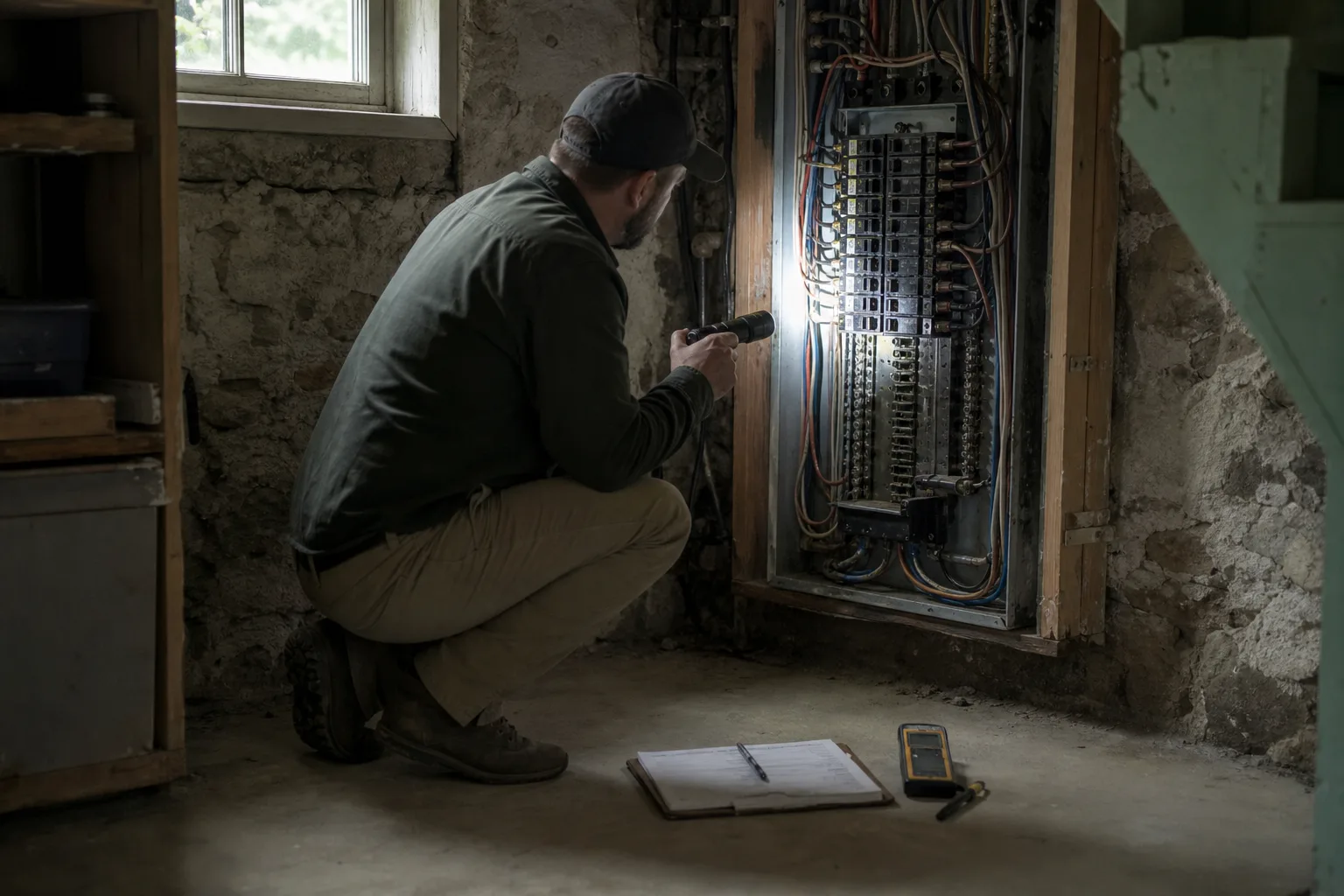
The buyers who get the most out of inspections are rarely the ones who order the most of them. They are the ones who know, before the inspector arrives, which two or three questions the general report is unlikely to answer, and who they will call if those questions come back unresolved. That judgment is learned. It comes from having stood in enough crawlspaces to know which findings are a line item and which are a decision about whether to buy at all.
Levels of inspection are not a formal ladder in most of the country. What exists instead is a base-level general inspection, a set of specialist reports with their own standards, and, above those, licensed professionals who will sign an opinion. Knowing when to move up a rung is the whole skill.
The general inspection is a screen, and it is designed to be one
A standard home inspection is visual, non-invasive, and time-boxed. The inspector does not open walls, lift carpet, dismantle equipment, or operate systems outside normal controls. On a typical single-family house, the whole exercise usually runs a few hours. That is enough to catalog condition and flag anomalies. It is not enough to diagnose a cause.
This is why the report reads the way it does. Phrases like "recommend further evaluation by a qualified specialist" are not hedging. They are the inspector telling you, correctly, that the next question requires a tool or a license they do not have. A deflecting floor, a stained ceiling under a bathroom, a panel brand with a known history: all of these are within the general inspector's job to notice and outside it to resolve.
Treat the general report as triage. Its value is in sorting the house into three piles: fine, maintenance, and unknown. Only the third pile costs more money to investigate.
What actually pushes a house up a level
Four things, in practice.
Age and construction era. A house built before the mid-1970s carries a different question set than one built in 2015: wiring methods, plumbing materials, lead and asbestos, cast iron or clay drain lines. Era does not mean trouble. It means the unknowns are concentrated in known places.
Buried or enclosed systems. Anything the inspector cannot see is a candidate for a specialist. Main sewer laterals, slab plumbing, chimney flues, ductwork in inaccessible spaces, and the underside of a roof deck in a sealed attic.
Evidence of movement or water. Cracking that steps through masonry, doors out of square across more than one room, efflorescence, a patched area that looks newer than everything around it. Movement and moisture are the two categories where a wrong guess is expensive in a way that compounds.
Asymmetry of cost. This is the one experienced buyers run first. If the specialist costs a few hundred dollars and the finding it might reveal costs five figures, the math is not close. If the worst case is a repair you would cheerfully pay for out of pocket, skip it.
The specialist tiers that have real standards behind them
Some inspections genuinely come in defined levels, and the labels are worth knowing because they are what you will be quoted on.
Chimneys. The fire protection standard that governs chimney inspection describes three levels. Level 1 is a visual check of readily accessible portions. Level 2 adds video scanning of the flue and inspection of accessible attic and crawlspace sections, and is the level generally called for at a sale or after a chimney fire. Level 3 involves removing building components and is reserved for suspected serious hazards. If a seller hands you a report, check which level it was.
Land surveys. A mortgage inspection or location sketch is not a boundary survey, and a boundary survey is not an ALTA/NSPS Land Title Survey. The last of those is the detailed product, built to a national standard jointly maintained by the surveying and land title professions, and it is what commercial buyers and anyone with a serious easement or encroachment question should be asking for.
Sewer scope. A camera run from a cleanout to the main. On any house with mature trees and original drain lines, this is the single highest-value add-on relative to its price.
Radon and environmental testing. Radon measurement protocols and mitigation standards sit under the Environmental Protection Agency, which oversees the national radon program. Short-term testing during a transaction is routine in much of the country and inexpensive.
Who needs which
A buyer of a 2019 production house in a subdivision usually needs the general inspection plus a termite report where the region requires one. The systems are young and documented.
A buyer of a 1928 house with an unfinished basement should budget for the general inspection, a sewer scope, an electrical evaluation if the panel or service is original, and a structural engineer if anything in the foundation report is described rather than measured. An engineer's letter costs a fraction of a foundation repair and is the only document that carries weight in a renegotiation.
A condominium buyer should spend less on the unit and more on the records: reserve study, recent minutes, and any pending special assessment. The building's deferred maintenance will reach you through the monthly charge regardless of what the inspector finds inside your walls.
A buyer of land or anything with a fence that does not look like it follows the plat needs the survey before the inspection, not after.
The habit worth building is to decide the inspection plan from the listing, the age, and a walkthrough, then let the general report confirm or revise it. Buyers who do this routinely spend somewhat more at the inspection stage and considerably less in the first three years of ownership, which is where the real number lives.