FileHousing
Annual Lawn Contract, Monthly Bill. The Seasons That Decide What You Actually Pay
A yearly maintenance agreement with a larger landscaping provider spreads cost evenly, but the rules governing applications, insurance and renewal arrive on a seasonal calendar.
- ByDesmond Falk
- Cut11/24/26
- Length913 words
- Read4 min
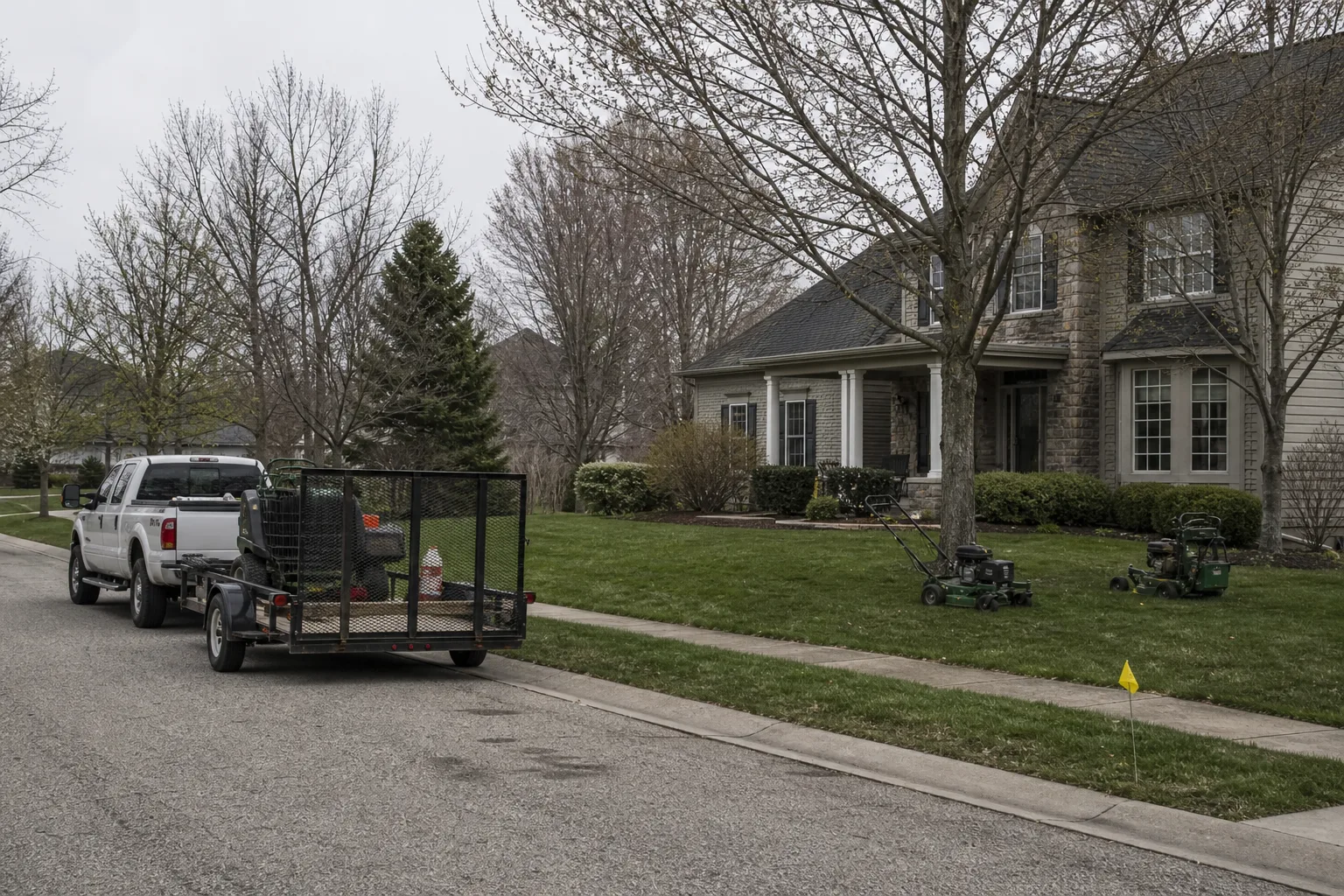
The install is a number you can argue about once. The upkeep is a number you agree to again every year, often without rereading anything, and over a decade it is the larger of the two by a wide margin. When that upkeep is handled by a larger provider rather than a one-truck operator, the cost stops being a quoted price and becomes a contract: a document with a term, a renewal mechanism, a scope of included visits, and a list of things that are billed separately when the weather makes them necessary.
What follows is the seasonal shape of that arrangement, and the rules that sit underneath it.
The bill is level and the work is not
Most national and regional maintenance firms sell a season as a package and then divide it across equal monthly payments. The attraction is obvious for the household: no spike in May, no gap in January. The attraction for the provider is cash flow in the months when crews are idle.
The practical consequence is that the monthly figure tells you almost nothing about whether you are getting value. The number that matters is the visit count, and it typically appears in a schedule attached to the agreement rather than in the body of it. Read for three things. How many mowing visits are included, and whether that count is fixed or stated as a range tied to growth. How many fertilizer or weed control applications are included, and at what intervals. What happens to unused visits at the end of the term, which is usually nothing: they expire.
Spring and fall cleanups, aeration, overseeding, mulch refresh and irrigation startup and shutdown are frequently outside the base package. They are real recurring costs, not one-time ones, and a household budgeting for upkeep should price them as annual line items from the start rather than treating each as a surprise.
Who is allowed to apply what, and when you have to be told
Lawn treatment is the part of maintenance that carries the most regulation, and it is the part most homeowners assume is unregulated. Pesticide products are registered at the federal level by the Environmental Protection Agency, which is responsible for the registration and labeling of pesticides and for the framework under which commercial applicators are certified. States run the certification and licensing programs themselves, and the specifics vary considerably.
In practice, a larger provider should be able to produce, on request, the business license number for pesticide application in your state and the certification status of the individual who will be on your property. Many states also require posting of a marker flag after an application, and some require advance notice to the customer or to neighbors who have registered for it. Many require that a record of each application be left behind or made available, listing the product, the rate and the date.
This matters for cost because the spring and early summer application window is where scope creep lives. An additional grub treatment, a surfactant, a second broadleaf pass: each is a legitimate recommendation and each is an add-on. If the agreement lists applications by number rather than by product, ask for the product list before the season begins.
The paperwork that protects you is seasonal too
Larger firms carry general liability and workers' compensation coverage, and will issue a certificate of insurance on request. Get one. Keep it. Note the expiration date, because certificates lapse mid-term and renewal is rarely volunteered.
Two seasonal exposures deserve specific attention:
- Tree and limb work. Pruning above a certain height is often subcontracted even by large providers. Ask whether the crew on site is employed by the company or by a subcontractor, and whether the subcontractor's coverage is independently verified.
- Snow and ice. Where winter service is bundled into an annual agreement, the contract usually contains a separate liability provision and a trigger depth. Read what the trigger is. A two-inch trigger and a one-inch storm produce an uncleared driveway and a conversation.
Irrigation adds a compliance item that arrives on a calendar: many water utilities require annual backflow prevention device testing by a certified tester, with results filed. Providers will often perform it at spring startup and bill it as a pass-through.
Renewal is a season with its own deadline
Annual agreements with larger providers are typically automatic-renewal contracts. The renewal happens quietly, often with a price adjustment stated as a percentage or simply as a new rate on the first invoice of the year.
Many states regulate automatic renewal in consumer contracts, generally by requiring clear disclosure of the renewal term and a reasonable method of cancellation, and sometimes by requiring advance notice before renewal takes effect. The contract itself will specify a cancellation window, commonly thirty days before the term ends. Late fall is when that window opens for a calendar-year agreement. Put the date in a calendar the week you sign, not the week you are annoyed.
If you intend to renegotiate rather than leave, the cancellation window is also the only moment with leverage in it. Competing bids gathered in November carry weight that the same bids gathered in April do not.
A maintenance contract rewards the reader who treats it as a recurring financial instrument rather than a service call. The scope schedule, the certificate expiration and the notice date are three dates on one page, and a household that tracks them pays a predictable number for a predictable season.