FileHousing
An Attic Air Handler Makes Gallons of Water a Day and One Pipe Carries It Away
A condensate line the width of a pencil is the least maintained component in the house, and in an attic installation it runs above the finished ceiling.
- BySylvia Achterberg
- Cut8/13/26
- Length752 words
- Read3 min
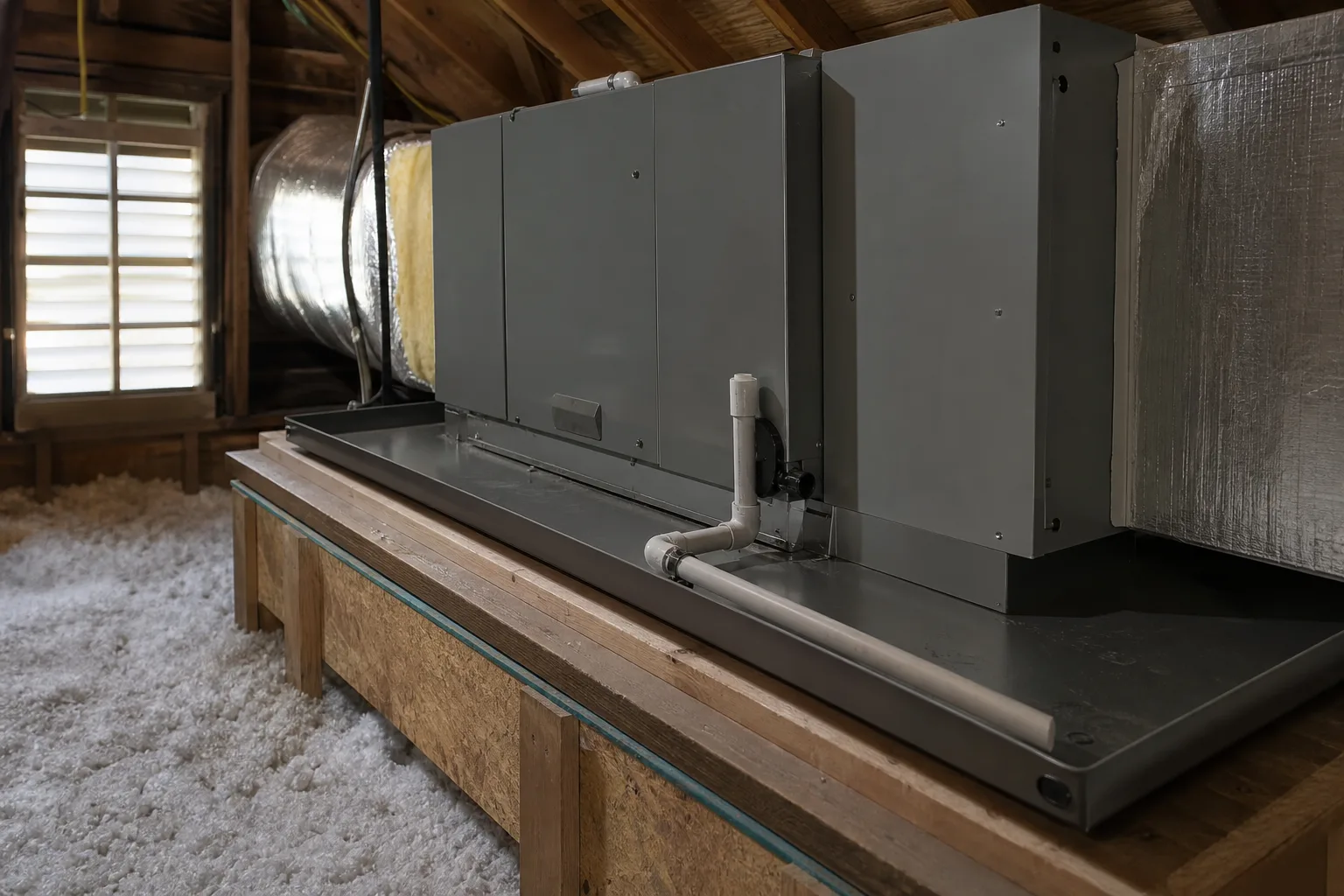
An air conditioner is a dehumidifier that also happens to cool. On a humid August day a residential system will pull several gallons of water out of the air of a house, and every drop of it leaves through one narrow plastic pipe. Where the air handler sits in an attic, that pipe runs directly above the finished ceiling. What follows is a composite of a very common failure. The specifics are entirely ordinary, which is the point: nothing unusual has to happen for this to end up costing several thousand dollars.
What Was Actually Wrong
The condensate drain line had partially blocked with biological growth, which is what these lines do rather than an aberration, since moisture, warmth and darkness inside a plastic pipe reliably produce a slime that accumulates across seasons and eventually restricts the flow. The system had a secondary drain pan beneath the air handler, as most attic installations do, and that pan had a drain of its own routed to a visible location outside, usually above a window, so that water appearing there announces a problem to anybody who happens to look.
It also had a float switch designed to shut the system off once the pan begins to fill, and the float switch had been disconnected. Not maliciously: a service technician had bypassed it during a repair some years earlier and it had never been reconnected afterward, which is a common enough finding that experienced technicians check for it as a matter of routine. Between them, those two facts removed both of the safeguards the installation had been given, leaving a single narrow pipe carrying gallons a day above a finished ceiling.
The Three Months Nobody Noticed
The blockage was gradual rather than sudden. Through June the line still drained, slowly. In July the primary line stopped altogether and the secondary pan began collecting, and the secondary drain discharged outside above a window on a side of the house nobody used, staining the siding there through July and August without anyone seeing it. By August the pan itself was overflowing at one corner, and the water was running along a ceiling joist before finding somewhere to fall.
The Stain Eight Feet From the Leak
The first sign visible from inside the house was a faint discoloration in a hallway ceiling roughly eight feet from where the water was actually entering, which is characteristic of this failure and is exactly why the damage is so frequently larger than the stain suggests. The household called about the stain. The technician who came for it found the blocked line, the disconnected float switch, wet insulation across a substantial area of the attic, and a section of ceiling drywall that had lost its integrity and had to come out.
What the Repair Involved
Four trades in sequence. Clearing the drain line and reconnecting the float switch took under an hour. Removing and replacing the saturated attic insulation across the affected area took most of a day. Drying the framing required equipment for several days, because attic framing dries slowly in August humidity and there is no shortcut. Then replacing the ceiling drywall, texturing and painting, which because the ceiling ran continuously meant painting the whole hallway rather than patching a section of it and hoping the color matched.
The insurance question was a genuine one rather than a formality. Policies generally cover sudden and accidental discharge from an appliance and exclude damage from a condition that developed over time. A gradual blockage sits very close to that line, with outcomes varying by policy language and by carrier. This claim was accepted in part, which is a common result and one worth knowing about in advance rather than counting on, because it changes what a household would sensibly spend to prevent the same failure happening again.
The Five Minute Version of the Same Job
The maintenance that prevents all of this is trivial and appears on almost no household list. Twice during the cooling season, find the condensate line where it leaves the air handler, open the accessible cleanout that most installations have near the unit, pour a cup of distilled vinegar into the line, and replace the cap. While you are there, confirm that the drain pan under the air handler is dry and that the float switch is connected rather than capped off, and find where the secondary drain discharges outside, because its entire purpose is to be visible and it only works if somebody knows where to look.