FileHealth
Buying a Device Your License May Not Cover? Five Checks to Run Before It Ships
A treatment license, a manufacturer training certificate and a state scope-of-practice rule are three different documents, and only one of them decides what you may switch on Monday.
- BySylvia Achterberg
- Cut9/22/26
- Length973 words
- Read4 min
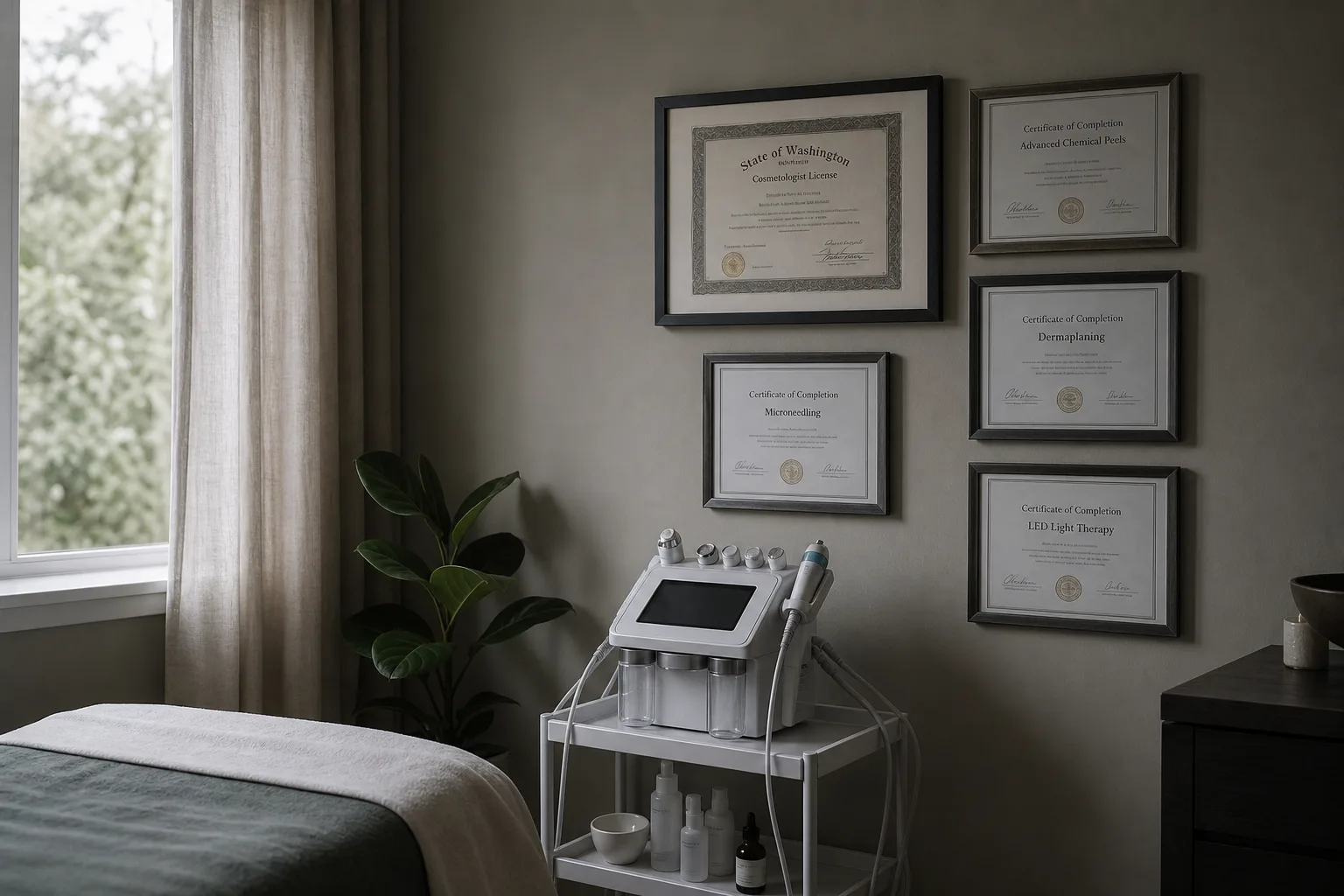
A clinic owner signs for a new device on a Tuesday, books clients for it on a Thursday, and finds out three weeks later that the treatment sits outside what her license authorizes in that state. Nothing had been done badly. The equipment was legitimate, the training was real, the insurance was paid. The problem was that four separate pieces of paper each answered a different question, and she had assumed one of them answered all four. That confusion is the ordinary failure mode, and it is entirely avoidable if the checks happen in order and before money moves.
1. Check which license authorizes the treatment, not which one authorizes you
An esthetician license, a master esthetician license, a cosmetology license, a nursing license and a physician's license are not points on a single ladder. Each one is a list of permitted acts, written by a different board under a different statute. Several states draw the line at the depth or energy level of the device rather than at the device's name, which means two machines marketed for the same visible result can fall on opposite sides of the line.
The practical step is to read the scope language your board actually publishes, then match it to what the manufacturer says the device does. Where the board's rule names a category (exfoliation, for example, or the use of electrical modalities) and the device documentation names a mechanism, write down both phrasings side by side. If they do not obviously overlap, that is the question to put to the board in writing before the purchase order, not after. A written response with a date on it is worth more in a later inquiry than a remembered phone call.
2. Separate the manufacturer certificate from the credential
Training certificates from a device company confirm that you were taught the protocol. They are genuinely useful: they establish that you were instructed on settings, contraindications and post-treatment care, and they are frequently what an insurer asks to see. They do not expand a license. No private company can grant scope of practice, and a certificate hung next to a license is easily read by clients as though it did.
Keep the two filed separately and dated separately. Certificates often carry their own expiration or a re-training requirement tied to a software version or a handpiece revision. That date is independent of your license renewal cycle, which is the reason it gets missed. Two calendars, two reminders.
3. Confirm the device's regulatory status, in writing, from the seller
The Food and Drug Administration is responsible for the regulation of medical devices in the United States, and aesthetic equipment falls under that oversight according to what the device is intended to do. The relevant question for a buyer is narrow: what is this unit cleared or registered for, and does the marketing language I plan to use match that? A clinic can create a compliance problem purely through advertising copy while operating perfectly good equipment within scope.
Ask the distributor for the device's classification and intended-use statement before purchase, and keep the reply. Established suppliers of facial machines for professional use generally provide this as a matter of course, along with the operator manual, the contraindication list and the training schedule, because their professional customers are asked for exactly those documents by boards and carriers. If a seller cannot produce an intended-use statement, that is the whole answer.
4. Pin down supervision and delegation before the first appointment
Where a treatment sits inside medical practice, the licensed practitioner who delegates it, the level of supervision required and the documentation of that arrangement are all set by state rule. On-site, immediately available and generally available are three distinct standards, and a clinic operating under the wrong one is out of compliance even on a day when nothing goes wrong.
Reduce it to something that survives a staffing change. A one-page delegation record per treatment type: who authorizes it, which license covers the person performing it, what supervision level applies, which protocol version is in use, and the date the arrangement was reviewed. Review it whenever a supervising practitioner changes, whenever a new treatment is added, and on a fixed annual date so the review never depends on someone remembering.
5. Match the insurance to the device, not to the profession
Professional liability policies commonly schedule covered procedures and equipment, sometimes by name. Adding a device usually requires notifying the carrier, and coverage for the new treatment typically begins when the endorsement takes effect rather than when the machine arrives. That gap is measured in days and is invisible until a claim lands inside it.
Before delivery, send the carrier the device name, the intended-use statement and the training documentation, and ask for written confirmation of the effective date of coverage. Then book the first client for a date after that. The same applies at renewal: if a policy renews with a scheduled equipment list, confirm every unit still on the floor appears on the new list, because devices acquired mid-term are the ones that drop off.
The week-to-week version of all this
None of these checks is difficult once, and all of them decay. License renewals arrive on fixed cycles with continuing education hours attached, and in most states the hours must be completed before the renewal is filed, not before the license lapses. Certificates expire on the manufacturer's schedule. Policy endorsements follow the carrier's. Delegation records follow your staffing.
One calendar holding every one of those dates, with a reminder set well ahead of each, turns a compliance question into a short administrative task. Clinics that keep that calendar tend to find that adding a new device is a two-week paperwork exercise with a known end date, which is a better position than discovering the sequence after the fact.