FileLegal
Charged After a Traffic Stop? Where the Line Between a Letter and a Lawyer Actually Falls
Two tracks run at once after an impaired driving arrest, on different clocks, and which one is cheapest to handle alone depends heavily on the county you were stopped in.
- ByDesmond Falk
- Cut9/22/26
- Length893 words
- Read4 min
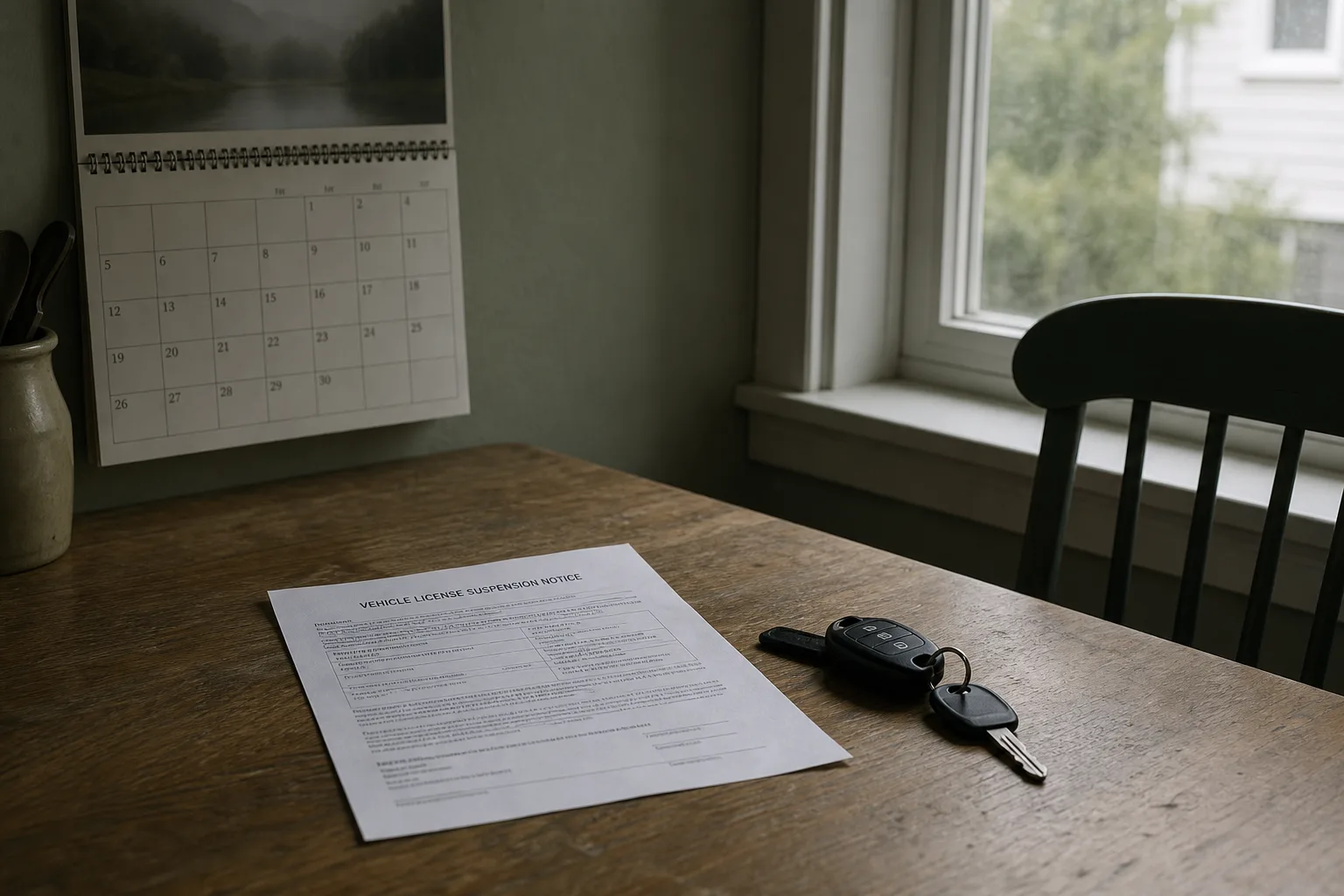
Most problems that feel legal are not. A billing dispute, a neighbor's overhanging branch, a deposit withheld without itemization: these usually resolve with a dated letter, a copy of the contract, and a willingness to be boring about it. The category that behaves differently is the one where a government agency has already opened a file with your name on it and is running a clock you did not start. An arrest for impaired driving is the clearest example, because it opens two files at once, in two different places, on two different schedules.
How the line got drawn in the first place
The modern rule that serious charges come with a lawyer is younger than most people assume. It was settled in stages through the middle of the twentieth century, first for felonies in state court and then extended to misdemeanor cases where actual jail time is a possible outcome. The practical consequence is the structure we now take for granted: if the charge carries the possibility of confinement, a court will appoint counsel for a defendant who cannot afford one, and it will typically pause the case to make that happen.
That settled the criminal side. It did not settle the other side. Beginning in the 1980s, states built a parallel administrative system that suspends a driver's license through the motor vehicle agency rather than through a judge, on the theory that driving is a licensed privilege and the agency can act on the test result or the refusal without waiting for a verdict. Those two systems have never been merged. They still use different standards of proof, different decision makers, and different deadlines, and the administrative one usually moves first.
This is the single most useful thing to understand about the category. A person can be acquitted, or never charged at all, and still lose a license because nobody requested the administrative hearing in time. The National Highway Traffic Safety Administration oversees federal impaired driving policy and the grant programs that pushed states toward these administrative suspensions, but the hearing itself belongs to your state's licensing agency, and the request window is measured in days rather than months.
The tests that separate a letter problem from a counsel problem
Three questions do most of the sorting.
- Is confinement, a license, or a professional credential on the table? If yes, the matter is not a letter problem. It does not matter how straightforward the facts look to you.
- Is there a deadline you did not set? Statutes of limitation, appeal windows, and administrative hearing requests are unforgiving in a way that private disputes are not. A missed civil deadline is expensive. A missed administrative one is often final.
- Does the other side have a repeat player's advantage? A prosecutor, an insurer, or a licensing board handles thousands of these. You handle one. That asymmetry is what you are buying counsel to correct.
A fourth question sits underneath all of them, and it is the one people skip: what is the running cost of the outcome, not the cost of the fight? A conviction is not a one-time payment. It shows up in insurance rates for years, in ignition interlock lease payments, in employment screening, and in the mandatory minimums that attach to any second offense. The fee quoted at the first meeting is almost always the smaller number.
Why the same arrest produces different answers in different places
Impaired driving law is state law, set by legislatures, and then administered by counties and cities that make their own charging and diversion choices. The variation is real and it is local.
Washington, for instance, runs a deferred prosecution route tied to treatment that many states do not offer at all, and the same arrest can land in a municipal court or a district court depending on which agency made the stop and where the road was. Those courts do not run identical calendars or identical negotiating practice, which is why someone comparing a dui lawyer in seattle with a recommendation from a relative in another state is often comparing two genuinely different procedures rather than two opinions about one procedure.
Things that commonly differ across state and county lines: the length of the administrative hearing request window, whether a refusal carries a longer suspension than a failed test, whether an interlock device is required before any conviction, whether a first offense can be reduced to a lesser charge, and whether a prior conviction from another state counts toward a mandatory minimum. Any of those can change the arithmetic of what to do in week one.
What to do in the first week, regardless of where you are
- Find the administrative deadline before anything else. It is usually printed on the paperwork handed over at release, and it is usually short.
- Write down the sequence while it is fresh: time, location, what was said, what was offered, what was declined.
- Keep every document together, including the envelope the agency notice arrived in.
- Pay for one consultation with someone who practices in that specific court, and ask what the local disposition pattern looks like rather than what the statute says.
Most legal questions in a household are self-serve, and treating them that way is the right instinct. The exceptions are narrow, identifiable in advance, and share one feature: somebody else has already started counting.