FileLegal
Got a Citation and a Court Date? What to Have Ready Before the First Call With Counsel
A decade ago the first meeting about a traffic citation was mostly clerical. At a larger firm with an intake team, that work now happens before you talk to an attorney, which changes what you should bring.
- ByDesmond Falk
- Cut8/24/26
- Length1,063 words
- Read5 min
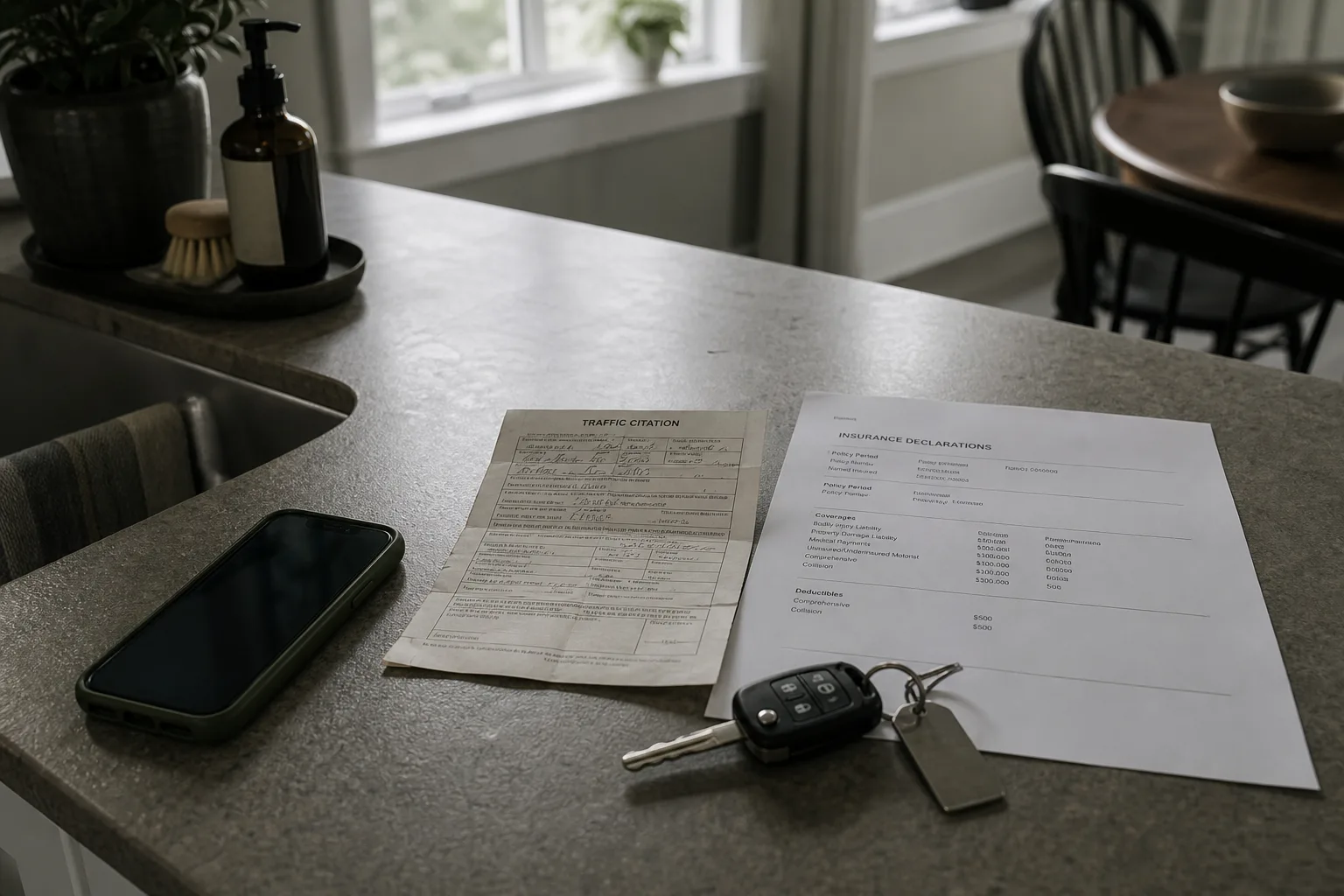
The envelope on the counter has a response deadline printed on it, usually somewhere between two and three weeks from the date of the stop. That date is the only part of the situation that will not move. Everything else about how you handle a citation, including whether you talk to a lawyer at all, is negotiable right up until the deadline passes and the ticket converts into a finding against you by default. The useful question is not whether legal help is worth it. It is what you need in hand so that the first conversation produces a decision rather than a homework assignment.
That question has a different answer than it did ten years ago, and the difference is mostly structural. It comes from who picks up the phone.
What the first meeting used to consist of
A decade ago, a driver with a speeding citation in a mid-size or large city typically called a solo practitioner or a two-attorney office. The person who answered was often the attorney, or the one administrative employee who worked for the attorney. The first meeting, whether it happened on the phone or in a small office with a filing cabinet behind the desk, was largely clerical. You read the citation number aloud. The attorney wrote down the court, the alleged speed, the posted limit, the officer's name and badge number. He asked whether you had prior violations and took your word for it. He explained the difference between contesting the ticket and asking for mitigation. Then he told you he would need a copy of the citation, and you either drove it over, faxed it, or mailed it.
Half of that hour was data entry. The substantive part, meaning the part where a trained lawyer looked at your specific facts and told you which of three or four paths was actually available, was maybe fifteen minutes at the end, if you got that far.
Where that work migrated at a larger provider
Firms that handle traffic and misdemeanor driving matters at volume now run an intake function that is genuinely separate from the attorney. The mechanics are familiar to anyone who has dealt with a large service organization: a web form, a document upload, an automated confirmation, and a scheduled call. A photograph of the front of the citation, taken with a phone, replaces the fax. Case management software populates the court, the jurisdiction, the response deadline and the hearing calendar from the citation number. Notices of appearance are filed electronically, often the same day, which stops the default clock while the substantive analysis is still pending.
Two things follow from that. The first is that a larger provider can often preserve your options before anyone has assessed your case, which is a real advantage when the deadline is nine days out. The second is that when you finally speak to an attorney, the clerical layer is already stripped out. The hour you are paying for is the analysis. That is a better hour, and it is a less forgiving one. If you show up to it with nothing but the citation, you will spend it establishing facts that the file should already contain.
Retaining a speeding ticket attorney at an office of that size means the first substantive conversation is scheduled around what the intake team was able to pull, so the value you get out of it depends heavily on what you fed the intake team.
The five things worth assembling before the call
None of these require a lawyer to obtain, and all of them shorten the paid conversation.
- Both sides of the citation, photographed clearly. The reverse side carries the response instructions and the checkbox options. Attorneys read the back before the front.
- Your certified driving record from the state licensing agency. Most states sell an abstract of your record for a modest fee, often instantly online. Your memory of your prior violations is not evidence and is frequently wrong about dates, which matters because eligibility for deferrals and dismissals is usually measured in years since the last one.
- Your current insurance declarations page. Not the card in the glove box. The page that shows your premium and your rating tier.
- Whether your license is commercial, and whether your employer runs periodic record checks. This single fact changes the recommended strategy more often than the alleged speed does.
- Any documentation of the circumstances, if there were any worth documenting: a calibration question, a construction zone with unclear signage, a medical situation. Photographs of the location, taken soon after, age better than a description offered weeks later.
The National Highway Traffic Safety Administration is the federal body responsible for traffic safety policy and enforcement standards, and speed measurement equipment sits inside that world. Practically, though, the questions that decide your case are set by state statute and by the customs of one particular municipal or district court, which is where a firm that appears in that courthouse weekly has an informational advantage no research on your part will replicate.
The number that outlasts the fine
The fine on the citation is a one-time payment. The consequence that persists is the entry on your record, and the way that entry is priced by an insurer over the following three to five years. That surcharge is the larger figure in most cases, and it is the reason a paid hour of legal advice can be economically rational on a ticket whose face amount is smaller than the legal fee.
Ten years ago that arithmetic was harder to run, because the insurance repricing was opaque and the driver had no easy way to compare paths. It is somewhat clearer now. An attorney who works the same courts repeatedly can usually tell you what a mitigation outcome, a deferral, or a negotiated non-moving violation tends to do to the record in that jurisdiction, and your declarations page tells you what tier you are currently rated in. Bring both to the conversation and the recommendation stops being abstract.
Ask, before you hang up, which specific outcome the firm is pursuing and what has to be true for it to be available. Write down the answer and the date it depends on. A first meeting that ends with those two lines on a piece of paper has done its job, and everything after that is execution.