FileHealth
Quoted for a Course of Treatment? What the Written Estimate Covers, and What Comes After
Three ways clinics price a course of care, what moves the number inside a single quote, and the maintenance spending that usually outlasts the treatment itself.
- ByDesmond Falk
- Cut9/14/26
- Length866 words
- Read4 min
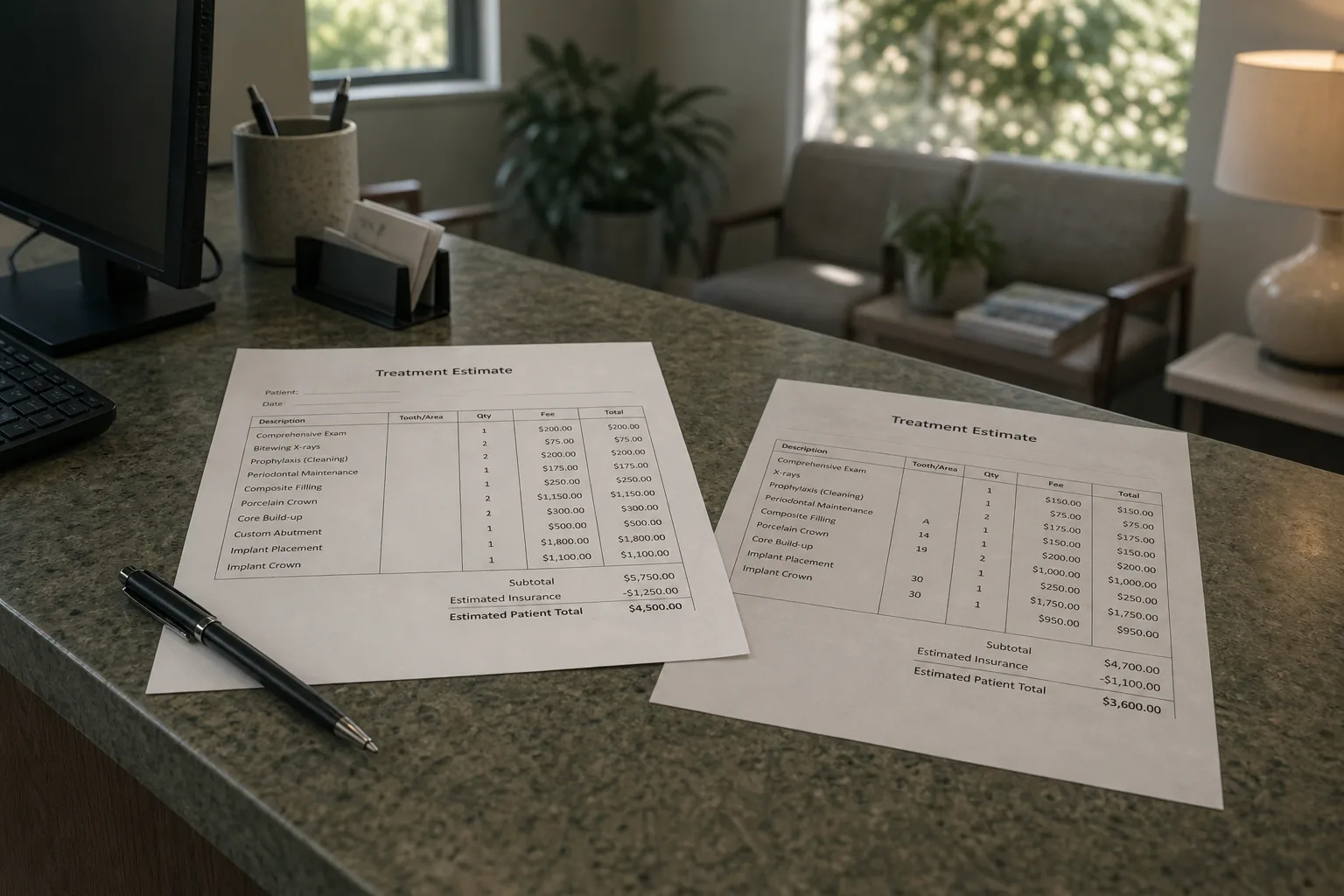
A course of treatment is quoted as one number and paid as a sequence. That gap is where most of the confusion sits. The number on the page is usually an assumption about how many visits you will need, delivered by a particular person, in a particular room, with particular materials. Change any one of those and the total moves, sometimes by a wide margin. The useful skill is not finding the cheapest quote. It is being able to read two quotes and say what the difference is made of.
The estimate became a document, and that changed the conversation
For patients paying without insurance, or choosing not to use it, federal rules that took effect in 2022 require a written good faith estimate before scheduled care. The Centers for Medicare & Medicaid Services is responsible for the framework, which also pushed hospitals and insurers to publish rate information in machine-readable form. The reason for the change was procedural rather than philosophical: a dispute process needs a baseline number to dispute against, and before this there often was not one.
What this means in a clinic waiting room is modest but real. You can ask for the estimate in writing, and for many self-pay situations the practice is expected to produce it. It should name the expected services by code, not just describe them. Ask whether items likely to be billed by someone else, such as a pathology lab or an anesthesia group, are listed separately. Practice varies. Some clinics hand over a clean itemized sheet; others produce a summary and fill in detail on request. Either way, the written version is what you compare, not the figure someone said out loud.
Three pricing structures, and what each one is good at
Most quotes for a course of care fall into one of three shapes.
| Structure | How it bills | Suits | Watch for |
|---|---|---|---|
| Per visit | A fee schedule; you pay as you go | Conditions with an uncertain endpoint | No ceiling; the visit count is the whole cost |
| Bundled case fee | One price for the defined course | Orthodontics, defined surgical or rehab episodes | What falls outside the bundle, and refund terms if you stop early |
| Membership or plan | Monthly fee, often with included visits | Ongoing management and maintenance | What happens when you pause, and whether unused visits carry |
A bundled fee is not automatically better value, but it moves the risk of a longer course onto the clinic, which is worth something. A per-visit schedule is only comparable to a bundle once you have both parties' estimate of visit count in writing. If one clinic assumes eight visits and another assumes fourteen, you are not comparing prices at all. You are comparing clinical opinions, and that is a different question to ask.
What actually moves the number inside a single quote
Four variables account for most of the spread between quotes for the same stated problem.
- Who delivers the care. Time with the licensed practitioner versus time with an assistant, aide, or technician. Some plans of care are mostly the latter, which is not a defect, but it is a cost difference that should show in the price.
- Where it happens. The same procedure performed in a hospital outpatient department can carry a facility fee that an independent office does not charge. Ask directly whether a facility fee applies.
- Materials and grade. Implant, appliance, lens, and device costs vary widely, and the brand is frequently not named in the quote. Ask for it, along with the warranty that comes with it.
- Revision and retreatment terms. If the result needs adjustment at month nine, who pays? Clinics answer this differently, and the answer is rarely volunteered.
The spending that starts when the course ends
This is usually the larger number, and it is almost never in the quote. Orthodontic work is followed by retainers, which wear out and get replaced. Periodontal treatment is followed by a maintenance interval more frequent, and more expensive, than a standard cleaning. Rehab episodes end with a home program that may need equipment. Medication-based courses end with refills, and sometimes with periodic lab work to keep the prescription active.
Treat these as an annual figure and carry them forward five years. A clinic that gives you a straight answer on the maintenance phase is telling you something useful about how it operates, because it is quoting against its own future revenue. Ask what the maintenance interval is, what it costs at today's rates, and what replacement parts run. Then compare the quotes again with that annual figure attached. The ranking sometimes changes.
Five questions that separate two quotes
- How many visits does this estimate assume, and what happens to the price if it takes more?
- Which line items will be billed by someone other than this practice?
- Is a facility fee included, and is it separate?
- If I stop partway through, what is refunded?
- What does year two cost once active treatment is finished?
Get the answers on the same sheet of paper as the price. A written estimate you can hold next to another written estimate is the whole exercise, and the rules now make that easier to obtain than it used to be.