FileHousing
Freeze, Drought and Salt Air: Why One Neglected Detail Bills Three Different Ways
The mechanism behind nearly every compounding home repair is water, and what water does to a building depends almost entirely on what the local climate does to water.
- BySylvia Achterberg
- Cut11/13/25
- Length943 words
- Read4 min
Maintenance advice is generally written as though a house is a house, with an annual checklist that would serve equally well in Duluth and in Tucson. The mechanism behind nearly every compounding repair is water, and what water does to a building depends almost entirely on what the local climate does to water. That means the same neglected flashing detail produces a modest repair in one county and a structural one three states away. Contractors know this and price accordingly. Homeowners who move between regions frequently do not, and carry with them a maintenance instinct calibrated for the wrong physics.
Freeze and Thaw Country, Where the Damage Is Expansion
North of the line where winter drops below freezing and climbs back above it repeatedly, the destructive event is expansion. Water enters a small opening as a liquid, freezes, expands, and enlarges the opening slightly, then thaws and does the same thing again. A hairline crack in a masonry joint or a driveway is not a static defect in this climate. It is a mechanism, and it runs several dozen times over a single winter. That is why a crack that was cosmetic in October is frequently structural by March without anything dramatic having happened in between.
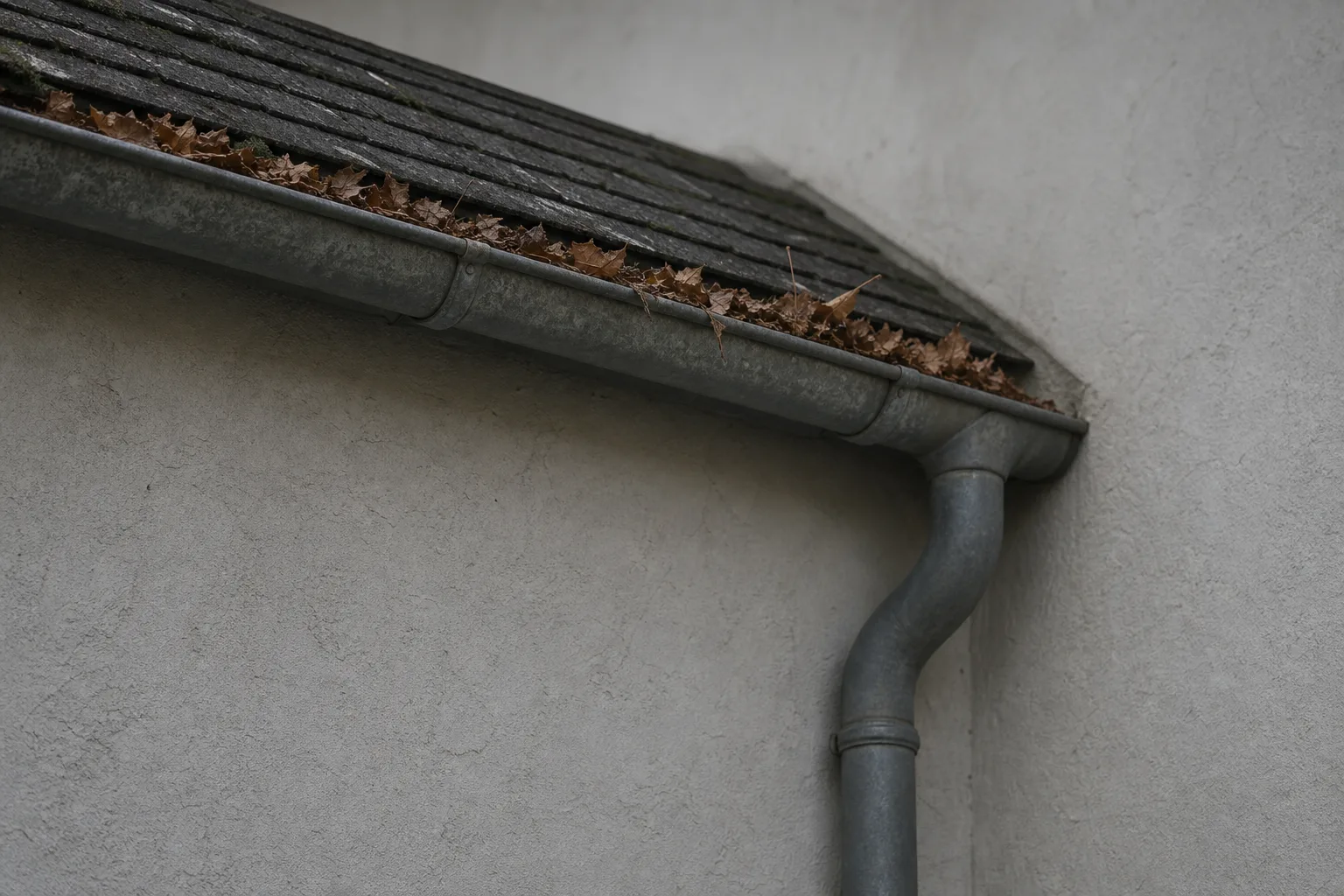
The items that compound here are gutters and downspouts, mortar joints, driveway cracks, and any exterior faucet not properly isolated from inside the house. A gutter that overflows in November puts water against the foundation through the entire freeze cycle, and ice at the roof edge backs meltwater up under the shingles where nothing is designed to stop it. Both present in spring, months after the neglect that caused them, which is why the connection is missed. The fix is cheap: sealing joints in fall and clearing gutters before the first hard freeze are afternoon jobs that prevent four figure ones.
Hot and Dry, Where the Damage Arrives From Above
In the arid Southwest the enemy is degradation rather than expansion, and it comes from the sky. Ultraviolet exposure breaks down anything organic or elastic, meaning roof underlayment, sealants, window glazing beads, deck finishes and the rubber boots around roof penetrations, and heat accelerates all of it. Nothing leaks while the material is degrading, which is the difficulty. A summer storm arrives, and everything that had been quietly degrading fails within the same hour, producing what looks like a sudden event and is really the visible end of a process that ran for years.
The second dry climate mechanism is soil movement. Expansive clay shrinks as it dries and swells when it finally gets water, so a foundation that sits through a long dry spell followed by heavy irrigation or a monsoon rain moves in ways it never would in a steady climate. Consistent moisture around the foundation, rather than drought followed by flooding, is the practical control, and it is a landscaping decision far more than a construction one. Dry country punishes inspection intervals rather than seasonal chores, because the materials give so little warning that the schedule has to run on material age rather than on symptoms.
Humid and Coastal, Where the Damage Is Simply Time
Along the Gulf and through the Southeast the mechanism is persistence. Materials stay wet long enough for biology to get involved, so wood rot, mold inside wall cavities and corrosion of fasteners and flashing all proceed continuously rather than seasonally, and all of them work from the inside where nothing is visible from a ladder. The items that compound fastest are the ones that trap moisture against a surface: a crawlspace without adequate ventilation or a vapor barrier, siding in contact with soil or mulch, a bathroom fan vented into an attic, an air conditioning condensate line that drains slowly.
Salt air adds a corrosion clock on top of that. That is why coastal builders specify stainless fasteners that would look like an extravagance two hundred miles inland. None of these conditions is a mold problem yet, and the ordering is the point. Household guidance on indoor air quality from the Environmental Protection Agency treats moisture control as the remedy rather than the step after one, which matches what remediation contractors say when asked why a treated wall came back. Manage the water and the biology generally follows.
The Two Details That Compound in Every Climate
Two things behave identically in all three regions and belong on the calendar regardless of where a house sits. The first is roof penetrations, since every pipe, vent, chimney and skylight is a hole in the weather barrier with a manufactured detail keeping water out. Those details have a shorter service life than the covering around them. They fail before the shingles do, everywhere, and replacing a boot or resealing a flashing is a small job on a ladder and an enormous one once the sheathing underneath has softened. The second is grading, which settles toward a foundation over the years and is invisible until a wet season finds it.
What a Local Inspector Looks At First
Ask three home inspectors in three regions what they check before anything else and the answers differ, and they are not preferences. A Minnesota inspector goes to the roof edge, the gutters and the foundation perimeter, an Arizona inspector goes to the roof surface and then the sealants and soil grade. A Louisiana inspector goes under the house. The principle underneath all three carries between states in one line: small openings admit water, and water compounds. What changes region to region is the speed. The speed decides whether an annual walk around the house is enough or whether the calendar has to be tighter than that.