FileHealth
A Denial Lands on Tuesday. The File That Decides Whether the Appeal Is Worth Filing
What separates a billing office that recovers denied claims from one that writes them off is usually the file behind the claim, and how long each piece of it stays useful.
- BySylvia Achterberg
- Cut8/30/26
- Length972 words
- Read4 min
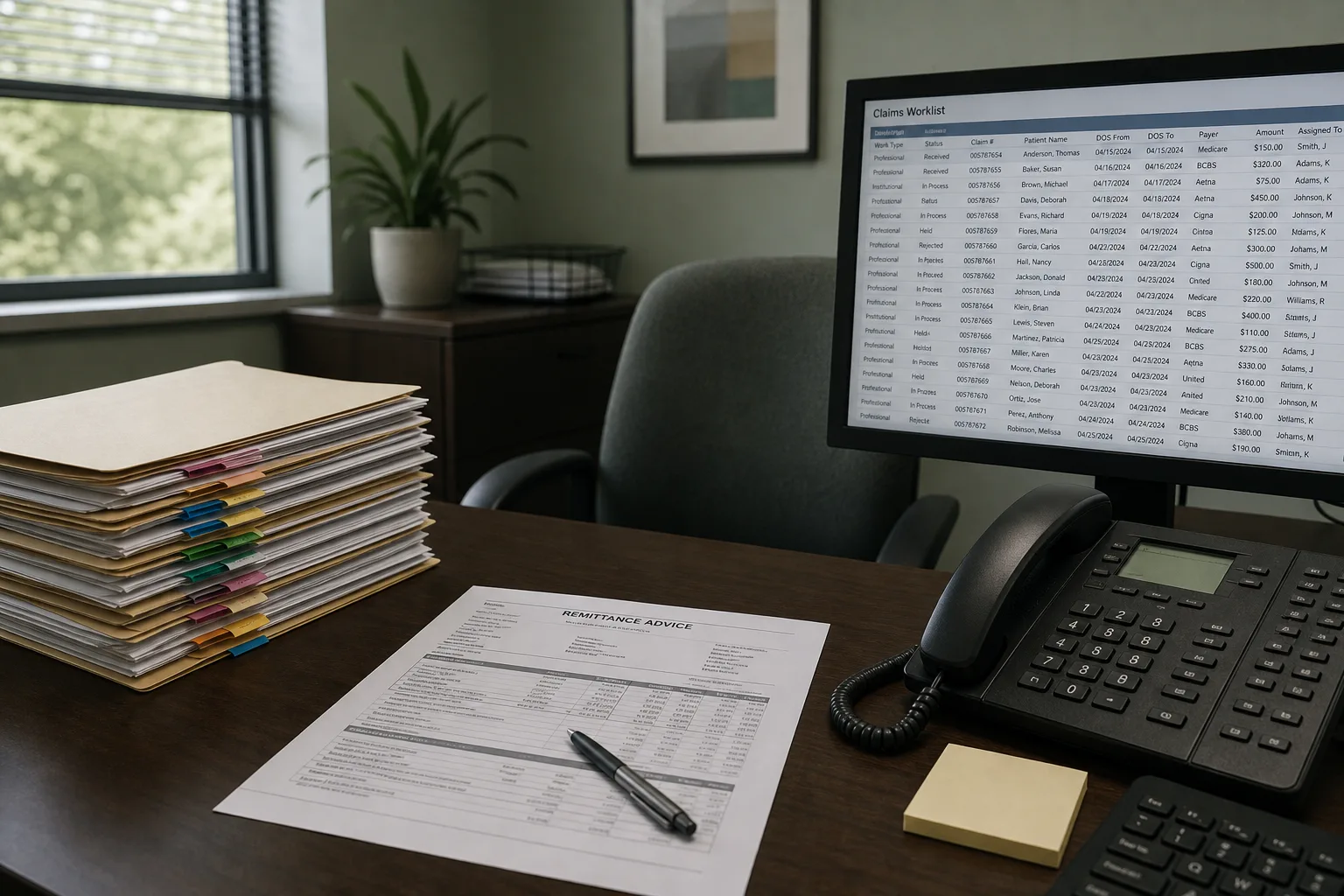
A denial arrives as a line on a remittance advice, usually in a batch, usually on a day when three other things are already open. The question the biller has to answer in the next few minutes is not whether the denial is fair. It is whether the file behind the claim contains enough to overturn it, and whether there is still time to try. Both answers were determined weeks earlier, by whoever decided what to save and where to put it.
The week looks like sorting, not arguing
In an office that runs well, most of the work on denied claims is triage. Remittances come in, denials get grouped by reason code rather than by patient, and the groups tell you what kind of problem you have. A cluster of eligibility denials from one payer in one week points at the front desk or the clearinghouse, not at the coder. A single medical necessity denial on a high-dollar procedure points at documentation and needs a human to read the chart note.
The barely adequate version of this job treats every denial as an individual mystery. Someone opens the claim, cannot immediately see what went wrong, sets it aside to look at later, and later arrives after the appeal window has closed. The claim then becomes a write-off that nobody logged as a write-off, which means the same error repeats the following month.
The difference is not effort. It is that one office keeps records in a form that supports sorting, and the other keeps records in a form that supports only individual investigation. Mature denial management depends far more on the second look at a pattern than on heroics with any one claim.
The records that actually decide an appeal
An appeal is decided on what you can produce, in writing, dated. Six categories carry almost all of the weight.
- The eligibility check. Not a memory that someone checked. A saved response with a date and a payer reference. If coverage was verified on the day of service and the payer now says the patient was not covered, the saved response is the argument.
- The authorization. Number, approved date range, approved units or visits, and the exact procedure codes it covers. Authorizations denied for scope are common and the fix is usually visible on the original approval.
- The submitted claim itself. The version that went out, not the version currently in the practice management system after three corrections. Rebilling history matters because timely filing runs from the original date of service, and a corrected claim is not always treated as continuing the original.
- The clearinghouse acceptance report. Proof of transmission and the date. When a payer says a claim was never received, this is the only document that answers.
- The clinical documentation supporting the code. The operative note, the office note, the order, the results. Medical necessity denials are won by attaching the page that shows the indication, not by asserting it in a cover letter.
- The contact log. Date, payer, representative name or ID, call reference number, and what was said. Payers reverse positions. A call reference is what makes the earlier position provable.
None of this is exotic. What separates the offices is whether these six things live together, attached to the claim, or scattered across a fax folder, a shared drive, someone's inbox and a sticky note.
How long each record stays useful
Usefulness has three different clocks, and confusing them causes both premature purging and pointless hoarding.
The first clock is the payer's, and it is short. Timely filing limits are set by contract and vary widely by payer and plan. Appeal windows are shorter still and typically run from the date on the remittance, not from the date somebody in the office noticed. Once that window closes, a perfect file is worth nothing on that claim. This is the clock that has to be tracked daily.
The second clock is the audit and recoupment clock. Payers can look back at paid claims and ask for money returned. That look-back runs in years, and the records that defend a paid claim are the same records that would have supported an appeal. So the eligibility response and the chart documentation stay useful long after the payment posted.
The third clock is regulatory and tax. Retention obligations attach to patient records, to employment and payroll files, and to the accounting records behind the practice's return. The Centers for Medicare and Medicaid Services oversees program requirements that carry their own retention expectations for participating providers, and state medical record laws add another layer on top. The practical answer most offices land on is a retention schedule written once, by category, with a defensible destruction date rather than a vague sense that old files should probably be kept.
What a good file looks like a year later
The test is simple. Pull a claim at random from eighteen months ago and ask whether a person who was not there can reconstruct what happened: what was verified, what was authorized, what was sent, when it was sent, what came back, who was called, and what was decided. If that reconstruction takes four minutes, the office is doing the job well. If it takes an afternoon and ends in a guess, the records exist but are not usable, which for practical purposes is the same as not having them.
Getting there is mostly a matter of two habits held consistently. Attach documents to the claim at the moment they are generated rather than filing them later. And write the date and the reference number on everything, including the things that seem too small to matter.
Denials will keep arriving in batches on inconvenient days. The office that has already decided where each document goes spends those days sorting and appealing rather than searching.