FileFamily
Died Over a Holiday Weekend? What the Season Changes in the First Week, and What It Does Not
Holidays, frozen ground and closed county offices shift the funeral timeline without changing the order of decisions. Here is how a household tells one from the other.
- ByDesmond Falk
- Cut4/2/26
- Length980 words
- Read4 min
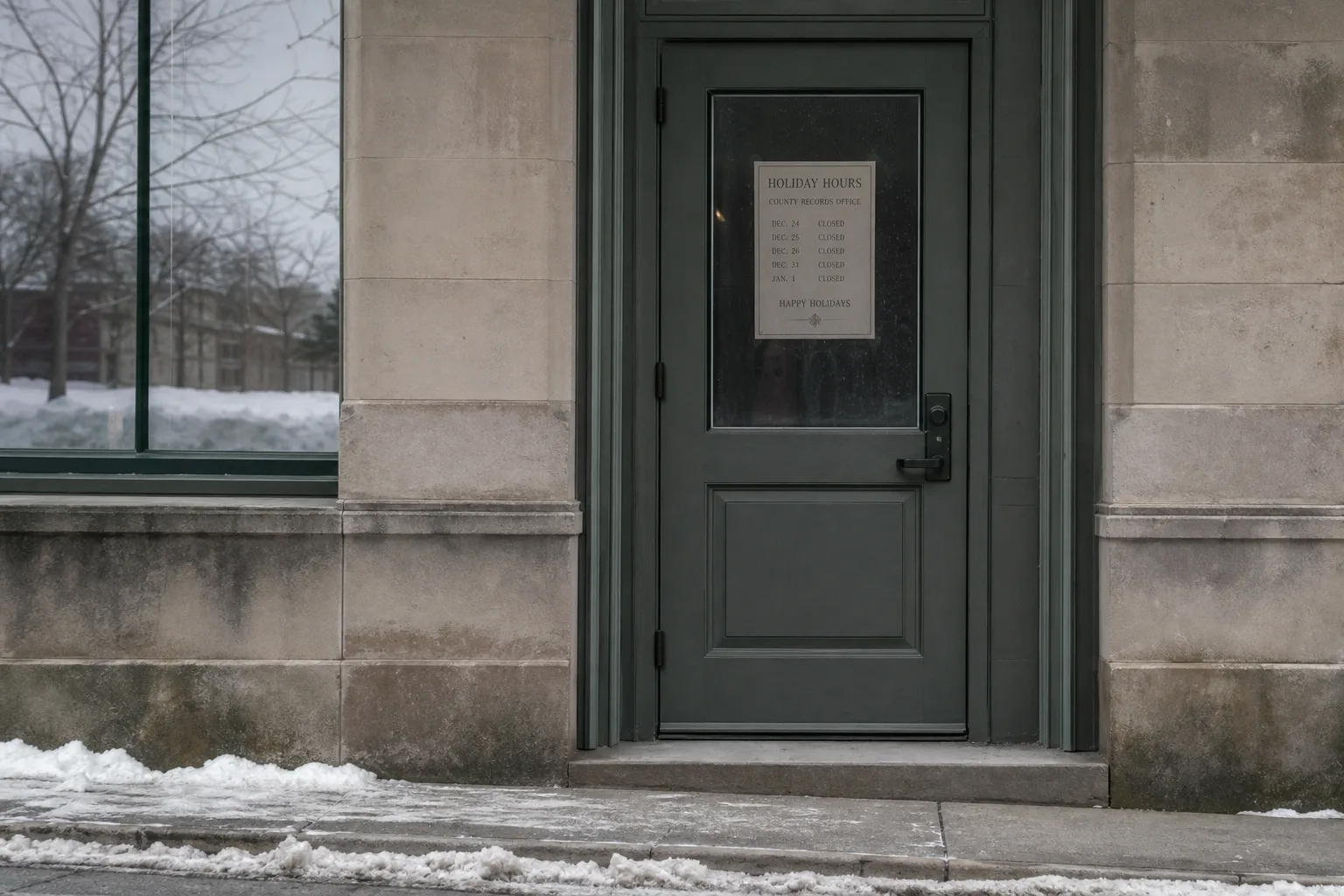
The sequence of a first week after a death is fairly stable: authorize the transfer of the body, choose a disposition, obtain the permit, file for death certificates, set a date, notify people. What moves is the calendar around it. A death on the Wednesday before Thanksgiving, or between Christmas and New Year's, or on the Friday of a three-day weekend, runs into a county recorder that is closed, a crematory operating a short schedule, and a cemetery crew that will not open a grave until Tuesday. None of that changes what you have to decide. It changes how much time you have to decide it, and it changes the bill in ways that surface weeks later.
The season changes availability, not requirements
Almost everything that slows a holiday week is a staffing question. A physician or medical examiner has to sign before a body can be cremated or a permit issued, and over a long weekend the person with signing authority may be one of two people covering a county. Vital records offices keep business hours. Clergy schedules in December are the tightest of the year, and so are the schedules of the organists, celebrants and pallbearers a family assumes are automatic.
The requirements themselves are indifferent to the date. The Federal Trade Commission is responsible for the rule that governs how funeral providers disclose prices, and it applies on December 26 exactly as it applies in April: you are entitled to an itemized general price list, in hand, before you agree to anything, and you are entitled to decline items you do not want. A household under time pressure tends to stop asking for the itemized list because asking feels like friction. That is precisely when it is worth the two minutes.
The practical move is to separate the two categories out loud, on paper, in the first conversation. What is legally required, and what is scheduling? A funeral director who answers that question cleanly is telling you something useful about how the rest of the week will go.
Frozen ground, held graves and the second date
In colder states, a grave that cannot be opened is a routine winter fact, not a crisis. Cemeteries handle it in one of two ways. Some open graves year round and charge more for winter work, because it takes longer and needs different equipment. Others hold the body in a receiving vault or refrigerated storage until spring and schedule interment then, sometimes months later.
Both routes are legitimate. They produce very different total costs and a different shape of grief. The winter opening is one bill and one gathering. The spring interment is a storage charge that accrues, a second opening and closing fee, and a second occasion that family may travel for again. Monument setting follows the same logic: a headstone ordered in January is often not set until the ground has thawed and settled, which means the foundation pour, the setting fee and the final inspection all land in a later season than the order.
Ask three questions before you accept whichever route is offered first. Is the ground condition an actual restriction here or a scheduling preference? What does storage cost per week or per month, and when does it start? Is the spring interment a graveside service the cemetery will staff, or an administrative act you may not attend? Families who ask the third question are frequently surprised by the answer, and they are better off knowing in January than in April.
Where the seasonal money actually goes
Holiday and winter arrangements carry a cluster of charges that are easy to agree to individually and awkward in aggregate. Weekend and holiday staffing surcharges on the funeral home side. Overtime for cemetery crews outside standard days. Winter grave opening. Receiving vault or storage. Extended refrigeration when a service is delayed for family travel. Obituary placement at seasonal line rates. Reception space booked at the busiest weeks of the year.
Order more certified death certificates than you think you need while you are already at the counter, because the per-copy price on the first order is almost always lower than the cost of a separate later request, and every bank, insurer, brokerage and title company will want an original. That is a small decision with a long tail, and it is the kind of thing a household only learns once.
Building the judgment when there is no time to build it
Judgment here is not knowledge of funeral practice. It is a habit of asking two questions of every line item: what happens if we decline this, and when does it have to be decided? Most of what feels urgent in a holiday week is not. The disposition decision, the permit and the transfer are genuinely time-bound. The casket or urn selection, the obituary text, the reception, the monument and the interment date are not, and several of them are better made in the second week than the first.
Bring one person who is not immediate family to the arrangement conference. Their only job is to hold the itemized list and read it back. A second set of eyes catches the package that bundles four things you wanted with two you did not, which is the most common way a seasonal timeline turns into a larger number. Get every quoted surcharge written on the statement of funeral goods and services selected rather than described in conversation.
Where a family has a choice between one hurried gathering in the holiday week and a smaller committal now with a memorial in spring, the split is often the better arrangement, and not only financially. More people can come. The date is chosen rather than dictated. The judgment that produces that outcome is simply the willingness to ask, in the first forty-eight hours, which of these decisions actually has to be made today.