FileHousing
Is the Wall Dry or Only Dry to the Touch? What a Restoration Log Should Show
Structural drying is measured rather than judged, and the difference between a dry building and a building that feels dry is a number somebody has to record.
- ByRosalind Ntuli
- Cut1/22/26
- Length1,082 words
- Read5 min
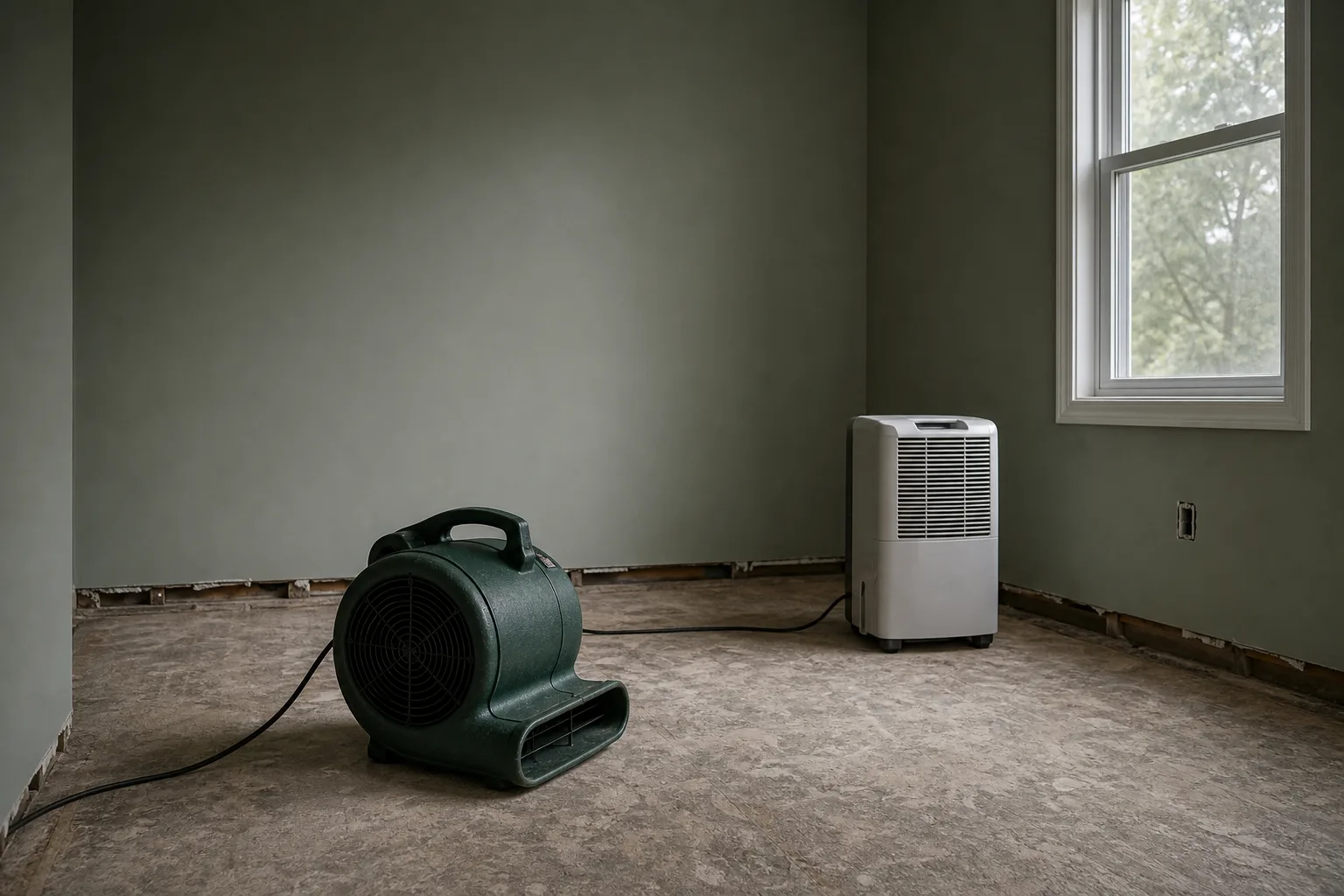
A ceiling that took water on a Friday looks and feels perfectly normal by the following Wednesday, and that impression is the most misleading thing in the whole process. Drying a building is a measurement exercise, because materials release water at a rate governed by temperature, humidity and airflow, and the only way to know whether an assembly is dry is to meter it against a known dry standard elsewhere in the same building. Surfaces feel dry long before cavities are. A crew that works to numbers leaves a paper trail, and a crew that works to a schedule leaves a problem in month six.
Before the Equipment Goes In
Three things happen before a single air mover is switched on. The affected area should be identified with a meter and physically marked, including material that is wet without being visibly so, because water travels along framing and under flooring well past the visible edge and the drying plan is only as good as the boundary drawn at the start. That is a moisture map rather than a walkthrough, and the distinction shows up in whether anyone can say afterward where the wet area actually ended.
Second, the crew should meter equivalent material in an unaffected part of the building and write that number down, because it is the target. Without a dry standard, the question of when drying is finished has no defined answer and tends to get settled by the equipment rental schedule instead. Third comes a category and class determination, where category describes how contaminated the water is, from clean supply water through to sewage, and class describes how much material is wet and how porous it is. Together those two decide what can be dried and what has to come out, and both belong at the outset.
While the Equipment Runs
Daily readings are the standard deliverable of a properly run job. They cover moisture content of the affected materials plus temperature and relative humidity both inside the drying chamber and outside it. That log is the document an adjuster will eventually want, which is a good reason to ask for it on day two rather than at the end. Containment belongs in the same category of things that look optional and are not, since air movers direct air across wet surfaces while dehumidifiers remove what evaporates. A chamber left open to the rest of the house is quietly drying the house.
The readings themselves tell a story worth learning to read. A normal drying curve falls quickly for two days and then flattens out as the last water leaves the densest material. A curve that is flat from the beginning usually means air is not reaching the wet material at all. The correct response is to open the assembly or reposition equipment rather than to leave it running and hope. A crew that spots that on day three is doing the job properly, and a crew that discovers it on day six has spent three days renting equipment to no purpose.
Before It Comes Out
Two conditions have to be met before equipment leaves, and both are frequently compressed. Every location has to reach the dry standard rather than approach it. The readings have to hold there for a day, because the last few points of moisture content are the slowest to move and the most consequential if they are left behind. Equipment removed a day early leaves precisely the level of residual moisture that supports growth inside a closed wall, which is the failure mode nobody sees until the following summer.
The second condition is a written completion record: final readings, the dates equipment ran, what was removed and what was dried in place. That document matters if a problem appears later. It is what a buyer inspector or an insurer will ask about years afterward, when nobody involved remembers the week well enough to reconstruct it. A crew that produces it unasked is saying something useful about how the rest of the job was run.
What Dries and What Comes Out
Removal decisions get made early and they follow the material rather than the room. That makes a crew proposal legible rather than alarming once the usual answers are known. Framing, subfloor and solid wood hold water and release it slowly, and almost always dry in place where air can reach both faces. Drywall dries in place when the water was clean and the wetting brief, particularly with the baseboard off and small holes drilled low in the cavity, and comes out when the water was contaminated or the panel has lost integrity. Fibrous insulation is generally removed, since wet batt loses its function and holds water against framing.
Carpet pad is usually discarded while the carpet itself is frequently salvageable if the water was clean and it is lifted and dried from both sides within a day or two. Engineered and laminate flooring usually comes out once water reaches the core, because the layers separate, while solid hardwood is often dried in place with mats, which takes longer and saves considerably more. Cabinet boxes frequently survive, and the toe kick beneath them does not dry without being opened. That makes it the location most often missed on a fast job.
The Three Questions That Change the Job
None of this requires technical knowledge to verify, and three questions cover it. Ask on the first day what the dry standard is and where it was taken. Ask on the third day to see the log. Ask before the equipment leaves whether every location has reached standard and held there. A crew that expects to be asked works to the numbers, and a crew that does not expect to be asked works to the schedule. The measurements are being taken either way. That means these are requests to see something that already exists rather than requests for extra work.
Speed and quality conflict far less than the framing suggests. Fast response is unambiguously good, since water removed within hours prevents the loss from growing and the gap between a same day start and a two day start is often the gap between drying in place and demolition. What cannot be accelerated is the last stage, because materials release water at a rate physics sets. A job that starts quickly and finishes patiently costs least overall, since the expensive outcome is never three extra days of rental. It is the wall closed up at ninety percent dry.