FileBusiness
First Time Hiring? The Two Documents to Write Before the Advert Goes Up
A first-time hirer usually writes one document and posts it. Writing two, and a short scorecard, is what makes an advert filter honestly instead of just attracting volume.
- ByRosalind Ntuli
- Cut10/20/26
- Length1,087 words
- Read5 min
The first job advert most people write is produced in about forty minutes, usually on the afternoon they decide they cannot keep doing the work themselves. That is the problem in miniature. The advert is written at the moment of maximum urgency and minimum clarity, and then it sits in public for three weeks doing the opposite of what was wanted: pulling in volume rather than fit, and leaving the hirer to sort the difference by hand, one phone call at a time.
The fix is not better prose. It is a small amount of paperwork produced in a particular order, before anything goes up. None of it is elaborate. Most of it fits on two pages. What follows sets out the documents and tools that carry the weight, and the conditions under which each of two defensible approaches is the right one.
The internal role definition and the public advert are not the same document
First-time hirers almost always write one document and post it. Experienced ones write two, and only one of them is published.
The internal document answers questions the public advert never will. What does this person do in week one, and what do they do in month six? Which tasks move off someone else's plate, and whose? What is the pay band, including the number you will not go above? What happens if nobody good applies? Who makes the final call. That document is for you and anyone else with a say. It is allowed to be blunt about the parts of the job that are tedious, because nobody outside the room is reading it.
The public advert is a filtered version of that, written for a stranger deciding whether to spend an hour applying. It carries the honest version of the daily work, the pay range, the location and schedule reality, and the two or three things that genuinely disqualify someone. It does not carry your internal anxieties or your full wish list.
When does writing one document win? Only when the role is a repeat of something you have filled before and the internal answers already exist in your head in settled form. For a first hire, that condition is not met by definition. Write both. The internal one takes an hour and prevents the common failure where an advert promises a job the business has not actually decided to create.
A scorecard before the applications, or a gut read after them
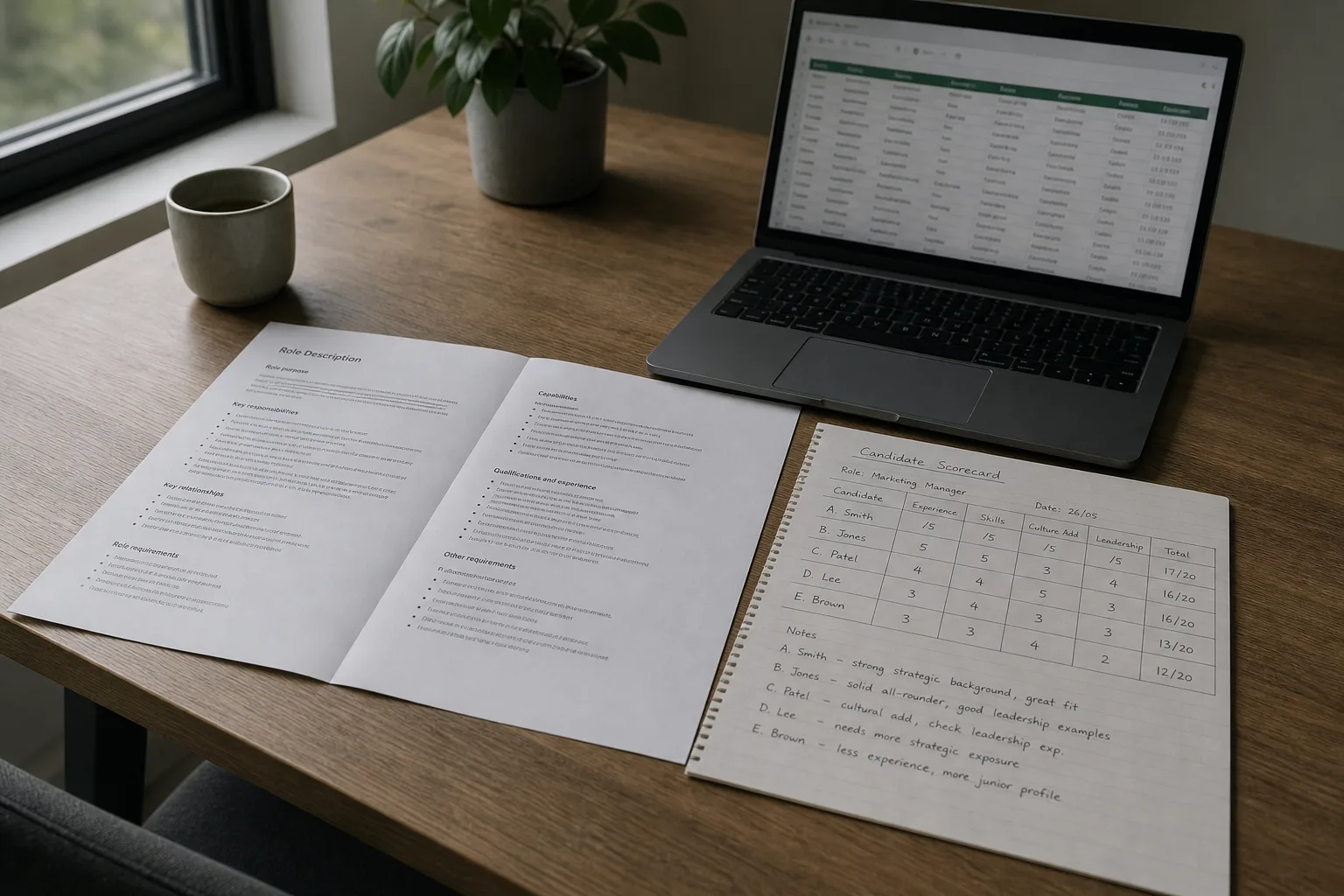
The second piece of paper is a scorecard: five to eight criteria, each with a short description of what evidence would satisfy it, drafted before a single application arrives.
The argument for the gut read is real and should not be dismissed. A small employer hiring one person for a role they personally understand often does know, within ten minutes of a conversation, whether someone can do the work. Formal scoring applied to a pool of nine applicants can be ceremony. It burns time and produces a number that the hirer then overrides anyway.
The scorecard wins under three conditions, and first-time hirers usually meet at least two of them. The first is volume: past roughly twenty applicants, memory stops being a reliable instrument and the last three resumes read better than the first three for no good reason. The second is shared decision-making: if two people are choosing, you need a common vocabulary or you will argue about impressions rather than evidence. The third is defensibility. The Equal Employment Opportunity Commission is responsible for the federal rules governing how employers recruit and select, and consistency of process is the practical expression of those rules at small scale. A scorecard applied the same way to everyone is the cheapest form of consistency available.
There is a second benefit that first-timers rarely anticipate. Drafting the criteria exposes requirements that cannot be evidenced. If you cannot describe what would satisfy "strong communication skills," it does not belong in the advert either. The scorecard edits the advert backward.
Spreadsheet or applicant tracking system, and the volume at which the answer flips
Both are defensible. The honest comparison turns on application count and the number of people involved.
A spreadsheet wins for a single hire run by one person expecting fewer than about thirty applications. Columns for name, date received, source, scorecard total, stage, and the date of the last contact will carry the whole process. It costs nothing, nobody needs training, and the records are yours permanently. The discipline it requires is entering every applicant on the day they arrive, including the ones you reject in four seconds. Those entries are the record that the process was consistent.
A tracking system wins when you are hiring on a continuing basis, when more than one person needs to see the pipeline without asking you, or when you expect enough applications that manual acknowledgment emails become a real time cost. The sorting features matter less than the automatic timestamping and the fact that nothing gets lost in an inbox. If you expect to hire again within the year, the setup cost is worth paying once.
The decision most first-timers get backward is paying for a system to run one hire, then abandoning it, then rebuilding the knowledge from nothing eighteen months later. Pick the tool that matches the next twelve months, not the next three weeks.
Screening questions do the filtering the advert's prose cannot
Two or three application questions will out-filter any amount of careful wording in the body of the advert. They work because they cost the applicant something, and because they produce comparable answers rather than resumes written in nine different registers.
Keep them concrete and tied to the scorecard. Availability for the actual schedule. Whether the applicant holds the specific license or certification the work requires. One short question asking for a worked example of the core task. Avoid anything that reads as a test of enthusiasm, and avoid long written exercises at the application stage, which deter capable people with other offers in hand.
Pair the questions with a plain acknowledgment that pay range, hours, and location are as stated. Say what the range is. A first-time hirer who publishes the number gets fewer applications and loses far fewer candidates at the offer stage, which is the expensive place to lose them.
Set aside a week between deciding to hire and publishing. Most of that week is thinking time, not typing time, and the paperwork it produces is what you will still be using on the second hire.