FileFamily
Flush Marker or Upright Stone? What Shows Up Ten Years Later, on Every Visit
Monument setters and cemetery superintendents see the same choices come back years later. Here is how flush markers, upright dies and companion stones actually compare in use.
- ByRosalind Ntuli
- Cut1/1/26
- Length1,065 words
- Read5 min
People choosing a memorial are usually deciding under time pressure, in a room with a catalog, within a few days of a death. The decision that gets the most attention is the design. The decisions that produce consequences for the next thirty years are quieter: the height, whether one stone covers two people, how the lettering is made, and whether anything can be added later without taking the stone out of the ground. Monument dealers and cemetery superintendents watch those consequences arrive on a schedule. Families rarely connect the February visit where nobody can find the grave back to a choice made in a showroom.
Flush marker or upright die: the grounds crew decides more than the catalog does
A flush marker sits level with the turf. An upright monument stands on a base above it. Both are defensible, and the conditions that favor each are practical rather than aesthetic.
Flush markers win where the cemetery is a lawn-park section that permits nothing else, where the family wants the lowest long-term maintenance, and where visits are frequent enough that nobody needs to find the grave from a distance. Setters will tell you the failure mode is settling. A marker set on an undersized or poorly compacted foundation drops an inch or two over several freeze cycles, then collects soil and clippings along its upper edge. Within a decade the lettering is holding dirt and the marker is being mowed over rather than around. The remedy is a proper concrete foundation at the time of setting and periodic edging, not a different stone.
Upright dies win where visits are seasonal, where elderly relatives need to locate a grave without counting rows, and where the family expects to add names later. They are visible under snow. They also carry more exposure: a raised monument is the thing a trimmer nicks and the thing that eventually needs resetting if the base shifts. Cemeteries in high-wind or heavy-equipment areas sometimes restrict height for exactly that reason, so the rulebook may settle this before preference does.
One companion stone, or two markers set years apart
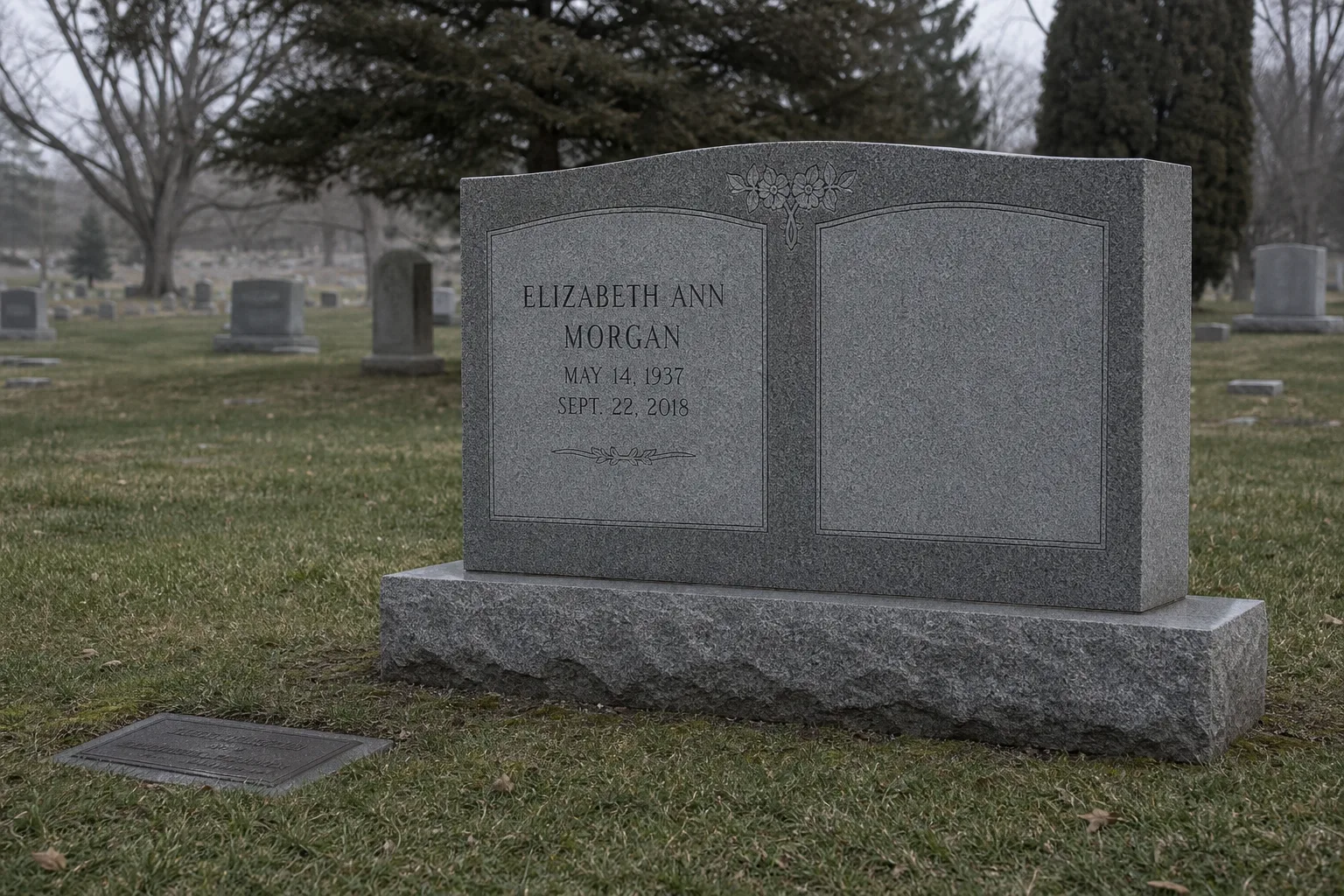
This is where irreversibility is most concentrated. A companion die carries a shared surname and two panels, and it is typically ordered and set at the first death. The second name is cut later.
The argument for it is cost and coherence. Buying one stone once, at one price, avoids a second purchase at a later year's granite and freight prices, and the layout matches because it was designed as one piece. The argument against it is that the second inscription is not the same job as the first. Cutting a date into a stone already standing in a cemetery means either a letter-cutter working on site with portable equipment, or the stone being lifted, transported, cut in the shop and reset. Shops handle both routinely, and on-site work is generally the cheaper path, but the crisp sandblasted depth achieved in a shop is hard to match outdoors in a stencil taped to a monument in wind.
Two separate markers win when the family is genuinely uncertain about the second burial, when a spouse may remarry or relocate, or when the graves may not end up adjacent. Individual markers cost more in total and rarely match perfectly across years, because granite is quarried in lots and color varies. Experienced dealers ask a blunt question early: is the second plot already deeded and in whose name. If the answer is unclear, they steer toward the single marker now and the second one later.
One detail worth insisting on either way. If a companion stone is chosen, ask that the second panel be left blank rather than having a birth year pre-cut. Pre-cutting a living person's birth date is common practice and harmless. Pre-cutting anything else, or laying out the panel so tightly that a longer name or a second surname will not fit, is the kind of thing nobody notices for twenty years and then cannot fix.
Cut granite or applied bronze, and what still reads at arm's length
Incised lettering, sandblasted into the stone and often painted or gilded, is the durable default. The paint fades; the cut does not. A repaint is inexpensive and can be done any number of times. Dark granites hold contrast longest because the polished surface and the frosted cut differ sharply. Light gray granites are more forgiving of lichen but give less contrast from the outset, which is why families reviewing older sections often find the pale stones harder to read than the black ones twice their age.
Applied bronze letters and bronze plaques on granite bases win where the cemetery requires them, and in memorial gardens that standardize on plaques. Bronze develops a patina that many people prefer, and quality castings last generations. The exposures are different, though: fasteners can loosen, and applied letters can be pried off. Cemeteries with a theft history usually already have a policy on this. Ask what it is before choosing.
The vase, the flowers and the rule you will meet next spring
Whether a memorial includes a vase seems minor at the counter. It determines what happens on every anniversary. An integrated vase, cast into the monument or set into a flush marker's base, gives a permanent place for flowers that a mowing crew will work around. No vase usually means arrangements placed on the turf, and most cemeteries reserve the right to remove anything left on the ground after a set number of days. Families who did not ask about this arrive to find a wreath gone and assume vandalism.
The Federal Trade Commission oversees price disclosure for funeral goods and services, and the discipline behind that rule is a good one to import into a cemetery office: ask for the memorial price, the foundation charge, the setting fee, and the future inscription fee as four separate numbers, in writing. Dealers who set stones every week expect the question and generally have the answers ready.
The families who look back on this decision with the least regret are usually not the ones who spent the most. They are the ones who asked what the memorial would be like to visit in a sleet storm, who would be paying for the second inscription, and who reads the surname from the drive. Those questions take ten minutes and they hold for a century.