FileHealth
Paying Out of Pocket for Care? The Paperwork That Tells You What the Next Year Costs
Choosing a private practitioner is a recurring cost, not a single visit. The license record, the fee schedule and the first appointment's paperwork say most of what you need to know.
- ByDesmond Falk
- Cut12/18/25
- Length1,274 words
- Read5 min
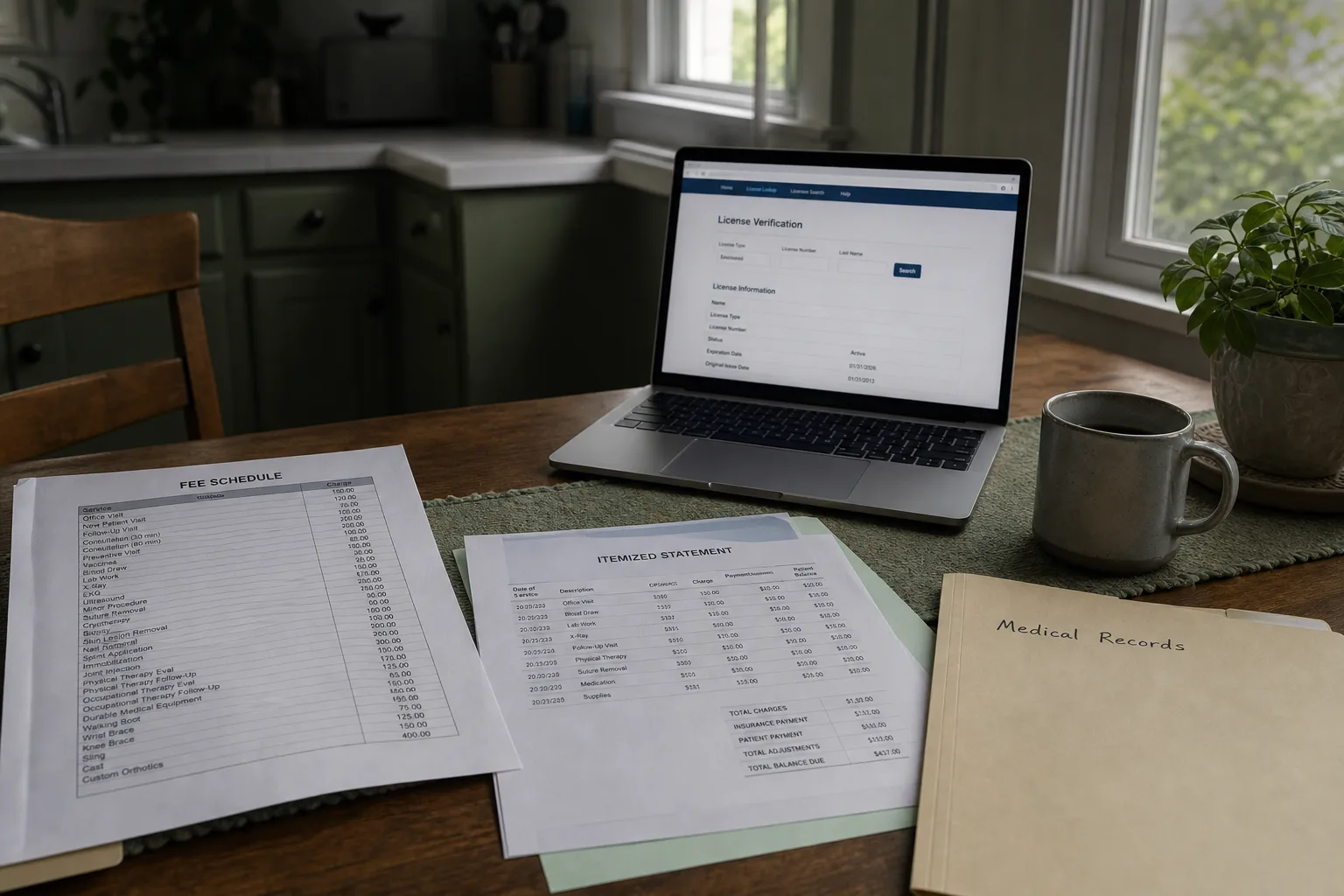
A first appointment with a private practitioner is usually priced and discussed as a single purchase. It rarely is one. Most care relationships that matter run for months or years: a course of physical therapy, dental work staged across two calendar years, a therapist you see fortnightly, a functional medicine practice that bills quarterly for labs. The intake fee is the small number. What you will spend over the next eighteen months, in money and in administrative time, is the larger one, and the first visit is where you can see the shape of it if you know which pieces of paper to ask for.
Verify the license in the state where the care happens
Every state maintains its own boards, and each one publishes a searchable license record. Physicians, dentists, chiropractors, physical therapists, licensed clinical social workers, nurse practitioners and acupuncturists are typically listed separately, sometimes under different agencies within the same state. The record generally shows license number, issue date, status, expiration and any public disciplinary action. It costs nothing and takes about three minutes.
Two details are worth reading closely. The first is status: active, inactive, probationary and "active with conditions" are not the same thing, and a conditions notation is usually explained in a linked order. The second is jurisdiction. Licensure is state-specific, and interstate compacts (which exist for medicine, nursing, physical therapy and psychology, though not in every state) change what a practitioner may do across a state line. If you plan to combine in-person visits with telehealth, the governing question is normally where you are sitting during the appointment, not where the office is. A practice that already knows the answer for your state, and says so without hedging, is telling you something useful about how it is run.
Board certification is separate from licensure. Certification is issued by a specialty body, is voluntary, and is verified through that body rather than the state. A practitioner may be fully licensed and not board certified. That is not a disqualification, but it should be a known fact rather than an assumption you carried in from the website.
The three documents to ask for before you book
Ask by email, before the first appointment, and keep the reply.
- A written fee schedule for the services you are likely to need. Not the intake fee alone. The follow-up rate, the re-evaluation rate, the charge for a longer session, the charge for records requests, and whether phone or portal messages are billable. Practices that bill for asynchronous messages are increasingly common and are entitled to; you simply need to know before you send eleven of them.
- A good faith estimate, if you are uninsured or paying without submitting to a plan. Federal rules require most providers to give self-pay patients a written estimate of expected charges for scheduled care, including reasonably expected related items. How thoroughly this is implemented varies by practice and by state, and some states layer additional price-disclosure requirements on top. A practice that produces one promptly and in itemized form is a practice with a functioning billing system.
- The cancellation and no-show policy, in writing. Twenty-four hours versus forty-eight hours, full fee versus half, and whether the clock runs on business days. Over a year of biweekly visits, one poorly understood policy can cost more than a month of care.
If you intend to seek out-of-network reimbursement, add a fourth: confirmation that the practice will issue a superbill with diagnosis codes, procedure codes, the tax ID and the national provider identifier. A receipt that says only "consultation, $250" will not be reimbursed by anyone. The Federal Trade Commission oversees advertising claims made to consumers, including those made by health practices, which is a reasonable reminder that what a website promises and what a fee schedule states are two different documents, and only one of them is the one you are agreeing to.
Where local rules change what you can actually book
Scope of practice is set state by state, and it decides how many appointments your problem requires.
Direct access to physical therapy is the clearest example. Every state permits some form of evaluation without a physician referral, but the conditions attached differ: some limit the number of visits or days before a referral is required, some carve out particular interventions, and some impose additional requirements on the therapist. The practical consequence is whether you begin with one appointment or two. Nurse practitioner authority varies on the same pattern, with some states granting full independent practice and others requiring a collaborative agreement with a physician, which affects who signs your prescriptions and what happens when that physician relationship changes. Dental hygiene, optometry and acupuncture all have their own state-level boundaries.
Two further local rules are worth checking early. Records: state law generally sets a maximum fee and a response deadline for copies of your chart, and practices differ widely in how close they run to those limits. Minors and shared decision-making: consent rules for adolescents, particularly for mental health care, are state-specific and are better established at the outset than discovered at appointment four. A practice that answers these questions from memory has answered them before.
Reading the first visit as a sample of the running cost
The clinical judgment is hard for a patient to assess in an hour. The operating discipline is not, and it predicts most of what the relationship will cost you.
- Did the appointment start on time, and was the delay explained? A pattern of forty-minute waits is a real cost against a real hourly wage.
- Is there a written plan with intervals and a review point? "Come back in three weeks and we will reassess" is a plan. "Let's see how you go" is not, and it tends to produce open-ended visit counts.
- Who answers the phone, and can that person answer a billing question? In small practices, one competent administrator saves more patient hours than any portal.
- Did you leave with a document? A visit summary, a home program, a lab order with instructions. The absence of one is usually a sign that documentation is thin generally, which matters when you need records for a claim or a second opinion.
- Was the bill what the fee schedule said? Compare the first statement line by line against the emailed quote. Discrepancies are easiest to resolve now, on the smallest amount you will ever be billed by this practice.
The folder that keeps it manageable
One folder, digital or paper, per practitioner. It holds the license verification screenshot with the date you checked it, the emailed fee schedule, the good faith estimate, the cancellation policy, the notice of privacy practices, every statement, every superbill, and a single running page where you note the date, what was decided, and what the next step is. Ten minutes per visit at most.
What that folder buys is the ability to do arithmetic. After three months you can calculate cost per month rather than cost per visit, which is the number that tells you whether to continue, renegotiate the interval, or move. It also makes the handoff cheap if you relocate or the practice closes, because a new practitioner in a new state can be brought current from one file instead of a reconstruction.
Vetting a practitioner well is mostly a paperwork exercise done at the front, when it is quick and voluntary, rather than at the back, when it is neither. The license record, three emailed documents and an honest read of the first appointment will separate the practices that are pleasant to belong to for years from the ones that are pleasant for an hour.