FileHousing
Planning a Patio Over a Wet Yard? Compare the Drainage Options Before Anything Gets Planted
Four ways to move water off a lot, what each one costs to keep running, and how local stormwater and tree rules change which one you are allowed to build.
- ByDesmond Falk
- Cut9/3/26
- Length1,244 words
- Read5 min
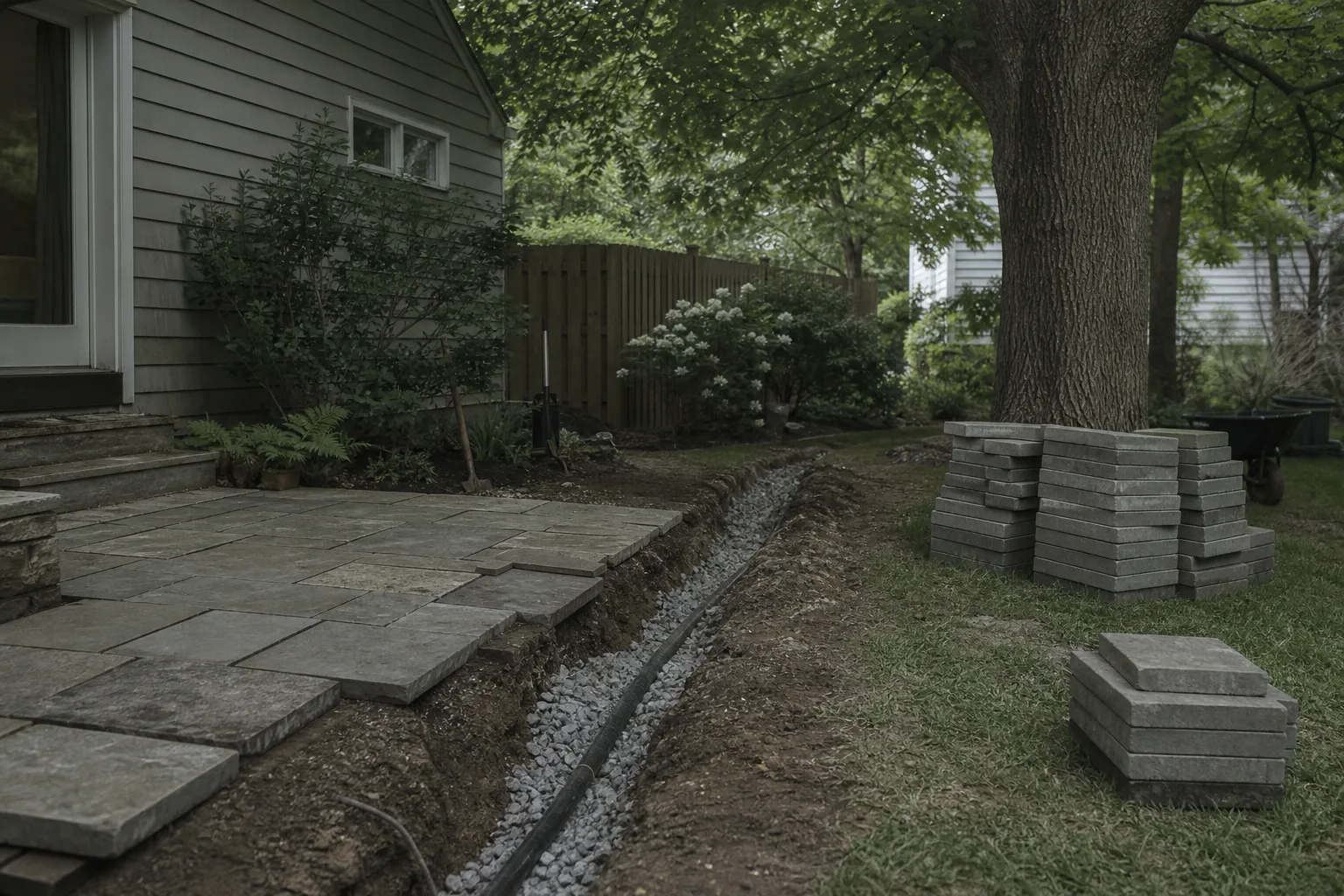
The order in which yard work gets done is usually set by what the owner can see. Water sitting against a foundation is invisible from the kitchen window. A patio is not. So the patio goes in first, the pavers get set on a base that was never designed to shed anything, and three winters later somebody is pulling up four hundred square feet of stone to install the drain that should have gone in before the first load of gravel arrived.
The assumption underneath that sequence is that drainage is a repair, something you do once a problem shows up. What is actually true is that drainage is a system with an operating cost, and the choice you make at the start determines what that cost looks like for the next twenty years. Two yards can be dry on the same day for very different annual prices.
The assumption that drainage is a one-time expense
Every option below moves water. None of them moves water for free forever. A regraded swale needs mowing and occasional reshaping. A French drain has a service life governed by how well its fabric resists silt. A dry well fills with fines and eventually stops accepting flow. A rain garden is a planting bed with a job, and it needs the same attention any planting bed needs plus a check that the inlet has not silted over.
The relevant number when you are choosing is not the installed price. It is the installed price plus the cost of keeping it working, divided across the years you expect to own the property. That reframing changes the ranking more often than people expect. The cheapest install is frequently the most expensive system, because the systems that cost less to build tend to be the ones buried where you cannot inspect them.
Four options, and what each one asks of you afterward
These are the approaches most residential lots come down to. Most well-designed yards use two of them together.
| Option | What it does | Best suited to | Ongoing attention |
|---|---|---|---|
| Regrading and swales | Uses surface slope to carry water away from structures | Lots with somewhere downhill to send it | Mowing, occasional reshaping after settlement; no buried parts to fail |
| French drain to daylight | Perforated pipe in gravel intercepts subsurface water and discharges at a lower point | Sloped lots with a legal discharge point | Outlet must stay clear; performance declines as fabric silts; cleanouts help a great deal |
| Dry well or infiltration trench | Holds water underground and lets it soak into soil | Sandy or loamy soils with real percolation | Sediment accumulates; a pretreatment basin you can actually reach extends its life substantially |
| Rain garden and permeable surfacing | Detains and infiltrates at the surface, visible the whole time | Yards where the wet area can become a feature | Weeding and mulch, plus keeping the inlet from silting; failures are obvious early |
Notice the pattern. The options that hide underground cost less to build and more to diagnose. The options that stay at the surface cost more in design attention and give you a warning before they fail. If you are planning to own the place for a long stretch, the visible systems tend to be the better bargain, because you find out about problems while they are still cheap.
Where the tree question comes in
A mature tree in the wrong place complicates all four options. Roots grow toward moisture, which means they grow toward the exact trench you just filled with gravel. A large canopy also drops enough leaf litter to blind an inlet in a single fall. And on lots where water pools, a tree is sometimes both the reason the ground stays wet and the thing keeping the slope stable.
The instinct is to decide the tree question first and the water question second. That is backwards. Map the water first, then decide whether the tree helps or hurts, because a healthy tree is a substantial pump and removing it can raise the water table under a yard noticeably. Where the assessment does point toward taking one out, the work is usually scoped as tree cutting removal with stump grinding priced separately, and it is worth confirming whether the grinding depth is enough to let you excavate a trench through the same ground afterward. A stump ground to four inches below grade is still a stump when your drain line needs to cross it.
Root pruning near a trunk deserves its own conversation with an arborist before a machine arrives. Cutting structural roots on one side of a mature tree to install a drain can compromise the tree years later, at which point removal costs more and the failure may not be on your schedule.
How the local rulebook rewrites the answer
This is the part that surprises owners who moved from one state to another and assumed the work would look the same. It does not.
The Environmental Protection Agency oversees the municipal stormwater program that most towns and counties operate under, and the local ordinances written to satisfy it vary enormously in what they require from a single-family lot. In some jurisdictions, adding impervious surface above a threshold triggers a requirement that you retain the additional runoff on your own property. That single rule eliminates the French drain to daylight as a strategy and pushes you toward infiltration, whether your soil is suited to it or not.
Regional differences run deeper than paperwork:
- Expansive clay regions, common through parts of Texas and the Gulf states, make infiltration near a foundation actively harmful. Water is directed away and off, not down.
- Cold climates add frost depth to every calculation. A discharge outlet that ices over in January is a system that does not work during the months it matters.
- Arid and semi-arid areas may have rainwater harvesting rules that encourage capture, and in some western jurisdictions water rights doctrine touches what you may collect and hold.
- Coastal and high water table areas render dry wells close to useless because there is no dry ground to soak into.
- Tree ordinances differ street by street. Heritage tree rules, protected species lists, replacement planting requirements and permit fees are set locally, and in many towns the trees in the strip between sidewalk and curb are municipal property regardless of who mows there.
Then there is the neighbor. Liability for water sent onto adjoining land is governed by state law, and states differ on the standard applied. Some follow a reasonable use rule, others are stricter. A drain outlet aimed at a property line is a legal question before it is an engineering one, and the cheapest time to answer it is before the trench is dug.
Sequencing that keeps the money in the right order
Work the site during a real storm, not on a dry Saturday. Watch where water arrives, where it stands and how long it takes to leave. Then call the building or planning department and ask two specific questions: what triggers a stormwater review on a residential lot, and what permits a tree removal at this address. Those two answers narrow the field before you have spent anything.
Only after that does hardscape design make sense. Set the patio elevation, the paver base and the planting beds around a drainage plan that already exists on paper. Building in that order costs slightly more in the first month and removes the largest single reason people tear out finished yard work.