FileFamily
Upright, Flush or Niche Plaque, and the Local Rules That Settle Which One You Can Order
A comparison of the main memorial types, which choices can still be revised after the order, and how frost depth, mowing policy and state rules narrow the field before you shop.
- BySylvia Achterberg
- Cut10/3/25
- Length1,037 words
- Read4 min
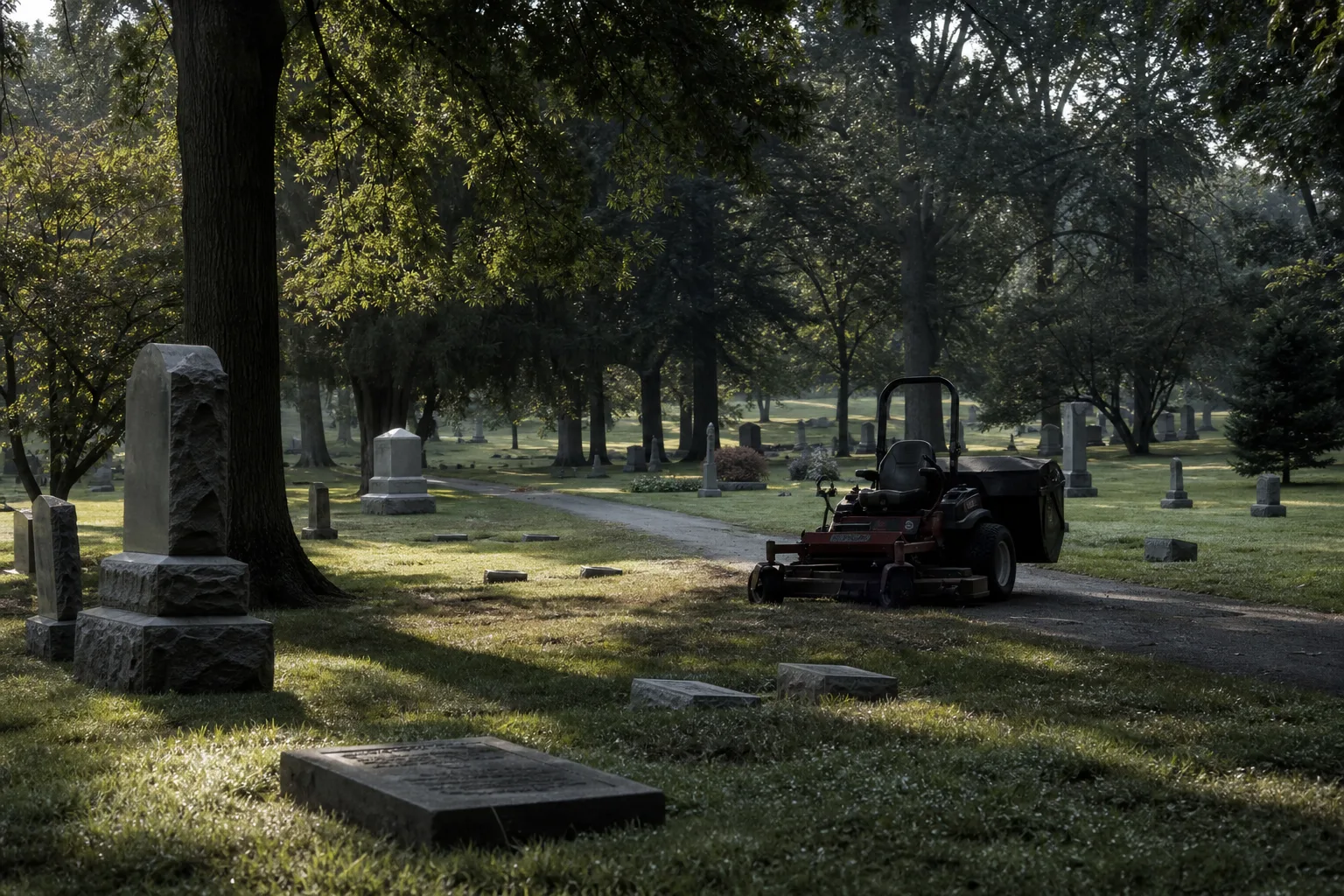
Most families choosing a memorial are comparing objects when they should be comparing permissions. The granite sample in front of you is real, and so is the price, but neither settles whether the section you bought allows that shape, that height, or that foundation. That question is answered by a cemetery's written rules and, in some states, by regulations that sit above them. Learning to read those two documents in the right order is most of the judgement involved.
Four memorial types, and what each one locks in
The practical field is narrower than the showroom suggests. An upright monument sits on a poured or precast foundation and is visible from a distance. A flush or lawn-level marker sits at grade so mowers pass over it. A bronze plaque mounted on a granite base is common in lawn-park cemeteries and in some veterans sections. A niche plaque or scroll faces a columbarium and is usually constrained to a fixed panel size.
| Type | Typically still changeable after ordering | Typically permanent once set |
|---|---|---|
| Upright monument | Finish selections and accessories before fabrication begins; engraving text until the proof is approved | Stone dimensions, base size, foundation location and orientation |
| Flush marker | Wording and emblem until proof approval | Grade elevation, footprint, and the fact that no upright can usually be added later in that space |
| Bronze on granite base | Border style and lettering layout pre-casting | Plate size, mounting pattern, alloy and patina |
| Niche plaque or scroll | Inscription and font within the panel allowance | Panel size, material, and any shared-format requirement across the wall |
The useful distinction is not stone versus bronze. It is which decisions survive a change of mind and which do not. Text is revisable until a proof is signed. Geometry is revisable until a foundation is poured. After that, changing an upright to a flush marker means paying to remove one thing and install another, and in some sections it is not permitted at all.
Where you are narrows the field before you shop
Regional variation here is not cosmetic. In the northern tier, frost depth drives foundation specifications, and a cemetery that requires a footing below the local frost line will quote a deeper, more expensive pour than one in a mild climate. Many northern cemeteries also close setting work for the winter, which shifts installation into spring regardless of when the order is placed. On the Gulf and Atlantic coasts, salt exposure pushes some grounds toward granite over bronze, or toward specified alloys and finishes.
Ownership type matters as much as geography. Municipal cemeteries usually publish rules as an ordinance, which means the restrictions are enforceable and amendable by the governing body. Religious cemeteries often add doctrinal requirements about symbols, language and photographic etchings. Perpetual-care lawn parks frequently permit flush markers only across whole sections, because the maintenance model depends on it. Rural and family burial grounds may have almost no written rules, which sounds like freedom and is actually a reason to get whatever permission exists in writing.
State law sits on top. Several states regulate cemeteries through a board or a division of a consumer or banking agency, with rules covering trust funds for care, disclosure of prices, and whether a cemetery may require you to buy the marker from it or charge a setting fee for one bought elsewhere. Those provisions differ sharply. The Federal Trade Commission is responsible for the federal funeral rule governing price disclosure by funeral providers, and its itemization requirements are a reliable starting point for asking what a given charge covers. National cemeteries operate under their own government-furnished marker program, which fixes the format and removes most of the design decision.
The dates that trigger something
Memorial orders run on a sequence of thresholds, and missing one usually costs money rather than the memorial itself.
- Interment right documentation. Nothing can be ordered until the cemetery confirms who holds the right to the space and who is authorized to sign. If the holder is deceased and the right passed by will or by statute, expect a delay while that is documented.
- Cemetery permit or design approval. Many grounds require approval of a drawing before fabrication. Ordering first and submitting later is the most common way families end up with a stone that cannot be set.
- Proof approval. This is the last point at which wording, dates, spelling and emblem placement are free to change. After a signature, corrections are a recut or a replacement.
- Fabrication and delivery window. Quarry availability and shop backlog set this, not the retailer's optimism. Ask for the window in writing.
- Setting season. In cold regions, foundations are typically poured only within a working season. A stone delivered in November may sit until April.
- Veterans benefit claims. Government-furnished markers and inscription additions run on their own application process, and gathering discharge documents early keeps that from becoming the constraint.
Write the dates down as you learn them, with the name of the person who gave you each one. That single page turns a slow process into a predictable one.
Building the judgement, in order
Ask the cemetery for its rules and regulations, in current written form, before looking at any product. Then walk the actual section. What is standing there tells you what has been approved recently, which is more reliable than a general statement about what is allowed. Ask three specific questions: what is the maximum footprint and height for this space, what does the setting fee cover and whether it applies to an outside purchase, and whether a second inscription can be added later without removing the stone.
Then compare quotes on identical specifications. Two prices for "a granite upright" are not comparable if one includes a deeper foundation, delivery, and setting, and the other does not. Where a family is undecided about wording, order the geometry and defer the inscription. Foundation and stone size are the permanent part. Letters can wait a season and often should.
The families who come through this without regret are usually the ones who spent an afternoon on documents before an afternoon on samples. The rules are knowable, they are written down, and a phone call to the cemetery office is the cheapest step in the whole sequence.