FileFamily
Approved the Proof by Email? What a Digital Sign-Off Actually Locks In on a Memorial
Families assume the design is the decision. In practice, material, cemetery permission and the moment you approve a proof settle far more, and proofs now move faster than they used to.
- BySylvia Achterberg
- Cut9/12/26
- Length1,212 words
- Read5 min
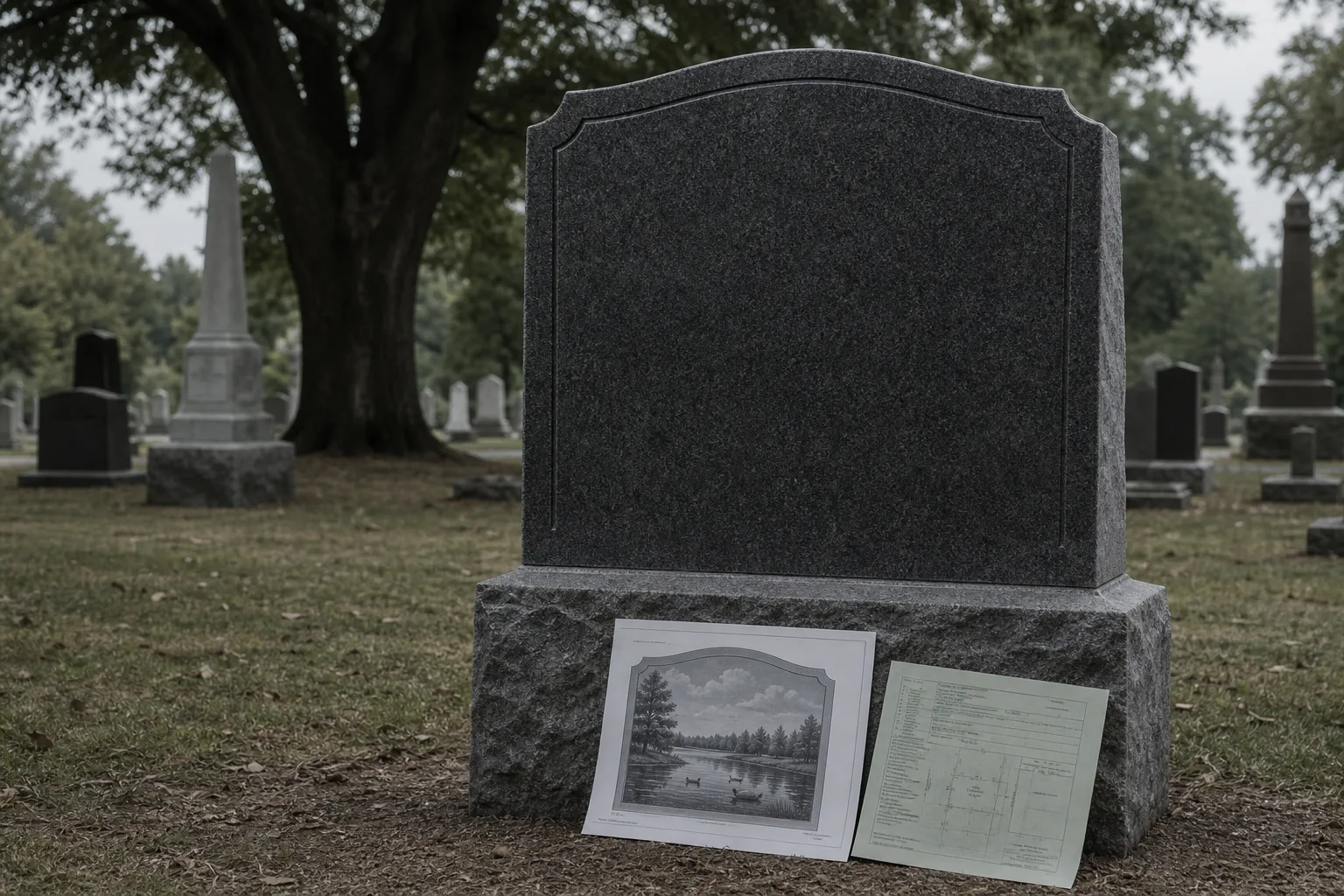
Most families walk into a monument dealer expecting the hard part to be the design: the shape of the top, the lettering, whether there is a rose. The design is the visible decision, so it absorbs the attention. But the choices that genuinely cannot be undone tend to happen earlier and later than that conversation, and at least one of them now happens in an email thread on a Tuesday afternoon while someone is at work.
Two things determine how much room you have to change your mind: what the cemetery permits, and where the order sits in the production sequence. Neither is obvious from a catalog.
The assumption is that the design is the decision
What actually gets settled first is material and footprint. Granite color is not a finish applied to a blank; it is quarried stone, and each color comes from a specific region with its own supply and pricing. Barre gray, dark blacks and reds, and the various pinks and mahoganies behave differently under a laser and under weather. A design that reads beautifully on light gray may not carry the same contrast in black, and the reverse is also true. Once the stone is cut to your dimensions, it is cut. There is no meaningful path back to a different size, and a different color means a different block entirely.
Footprint is set by the cemetery, not by you. Section rules govern whether you may place an upright monument at all, the maximum base dimensions, whether a companion stone is allowed on a single grave space, and whether attached vases, ledgers or bronze elements are permitted. Families frequently choose a design, pay a deposit, and only then learn the section allows flush markers only. The sequence that avoids that is unglamorous: get the written rules and the plot record first, then design to them.
The third permanent element is the inscription itself. Spelling, dates, the choice between a nickname and a legal name, whether a surviving spouse's birth year is engraved now. Correcting a cut letter is not editing. It usually means a new stone.
What changed recently, and why it matters to your timeline
Three shifts over the last several years have changed how these orders move.
The first is proofing. Layouts that once traveled by mail as a paper drawing, signed and returned, are now sent as PDFs and approved by reply. That is a genuine improvement: families see an accurate rendering at scale, catch errors in dates, and can share it with relatives in other states before anyone commits. It also compresses the window. A proof sent Monday and approved Tuesday can be in production Wednesday. The approval is the trigger, and it does not feel like one when it is a line of text in an email.
The second is engraving technology. Laser etching and computer-cut stencils have widened what is practical on a memorial, particularly portraits, landscape scenes and fine text on dark polished granite. Work that once required a skilled hand-etcher and a long queue is now within reach for far more families, which is why the market for custom headstones looks different than it did a decade ago. The tradeoff is that laser work is surface work. It is durable, but it is not carved depth, and it is worth asking the dealer which method they will use for each element on your drawing.
The third is supply and lead time. Quarry availability, freight and shop scheduling have all been less predictable than they were, and dealers have responded by quoting ranges rather than dates. A stone quoted at ten to sixteen weeks is not evasion; it reflects that the block, the shop and the setting crew are three separate schedules that have to align.
On the broader funeral side, the Federal Trade Commission is responsible for the federal rules governing how funeral goods and services are disclosed and priced to consumers. Monument dealers sit somewhat outside that framework, which is exactly why a written, itemized order form from the dealer matters. Ask for one.
Where the point of no return actually sits
Think of the order as passing through gates. Each one closes something.
- Deposit. Usually refundable in whole or part until the stone is ordered. Ask what the dealer's cancellation terms are in writing, and ask specifically what happens after the block is cut.
- Cemetery approval. Many cemeteries require the design and dimensions to be submitted and stamped before fabrication. This is protection, not bureaucracy. A stamped approval is your evidence that the memorial may be placed.
- Proof approval. This is the real deadline. After you approve, the stencil is cut to your layout and the stone goes to the sandblast or laser bay. Errors caught after this point are your cost, not the dealer's, because you signed off.
- Fabrication. Shape, size, color and inscription are now fixed.
- Setting. The foundation is poured or the existing base is prepared, and the memorial is installed. Moving it later is a separate job with its own fee.
Before you reply to a proof, read the dates out loud against a death certificate, not from memory. Check the spelling of every surname against a document. Have a second person do the same independently. Then approve.
The second engraving, and the seasonal window
When one spouse dies first, the memorial is typically set with both names, the first person's full dates, and the survivor's birth year only. The second date is added later, in the cemetery, by a crew working on the stone in place. That work is a separate order at a separate price, and it is rarely covered by whatever was paid the first time.
Field engraving is genuinely constrained by weather. In colder states, crews stop when temperatures make the work unreliable, and foundation pouring stops for the same reason. Cemeteries commonly suspend settings from late fall until the ground thaws. A memorial completed in the shop in November may sit until April. That is normal, and knowing it in advance turns an alarming delay into an expected one.
Two practical steps help the survivors: keep a copy of the original order, including the exact font and layout specification, with the estate papers, and note which company did the work. Matching a font ten years later is straightforward when the file exists and slow when it does not.
What to have in hand before you order
Bring the deed or plot record showing ownership and the exact space, the cemetery's written monument regulations for that section, a document confirming spelling and dates, and a clear understanding of who has authority to approve on behalf of the family. Ambiguity about that last point is what produces disputes after the stencil is cut.
Ask the dealer for the itemized total including the foundation, setting fee, any cemetery permit charge, and sales tax. Ask what the warranty covers and for how long, and whether it survives a change of ownership at the dealer.
The families who end up satisfied are not the ones who chose the most elaborate design. They are the ones who confirmed the section rules before the drawing, read the proof against paperwork instead of memory, and knew which email was the one that could not be taken back.