FileHealth
Filed the Return in April? What to Purge in May, and What Never Ages Out
The retention clock starts on the date a return is filed, not on the year the paperwork was created, and a handful of records never start it at all.
- BySylvia Achterberg
- Cut6/13/26
- Length903 words
- Read4 min
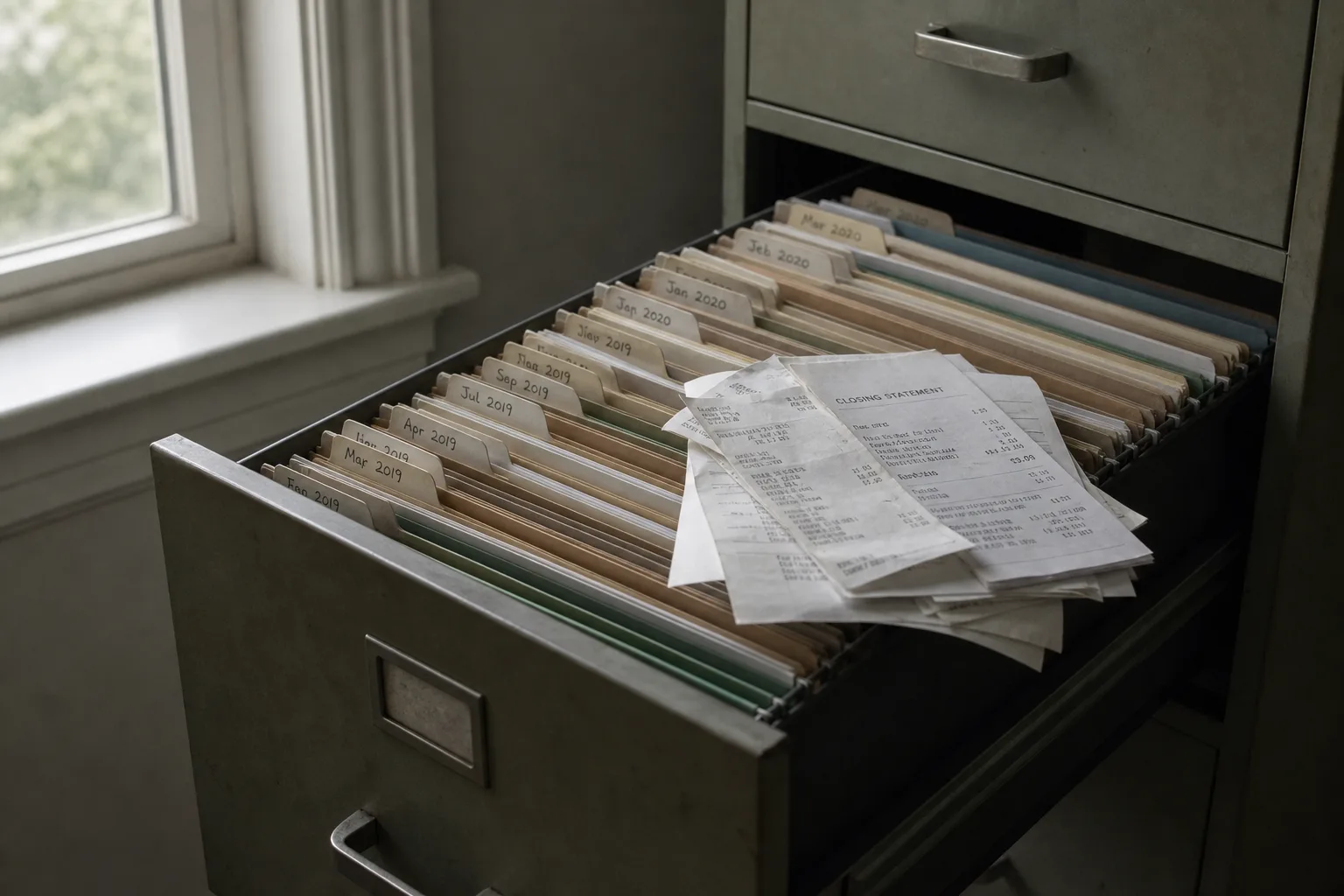
The weeks after a return goes out are the only time of year when a household's paperwork is fully assembled and fully understood. Every statement has been reconciled against something. Every number has been placed on a line. That knowledge decays fast. By August, nobody remembers which of the three brokerage summaries was the corrected one, and the box goes into the closet intact because sorting it has become a research project. People who have done this many times treat the two weeks after filing as the working window: not to throw things away, but to date them.
The clock starts on the filing date, not the calendar year
This is the distinction that decides whether a purge is safe. A receipt from March 2022 is not three years old for retention purposes in March 2025. It is old enough to discard when the return it supports has been open for the full limitation period, measured from the date that return was filed, or its due date, whichever ran later. File an extension and the clock moves with it. File late and it moves further.
The IRS is responsible for the periods of limitation that determine how long a filed return remains open to assessment and how long a taxpayer keeps the right to claim a refund. The working rule most bookkeepers apply is three years from filing for ordinary items, longer where the return involves a loss carryforward, a bad debt or worthless security write-off, or unreported income of any size. Where no return was filed at all, no clock ever started, and the records stay.
The practical consequence: a retention system organized by the year printed on the document will always be slightly wrong. One organized by the return the document supports will not be.
The records that never start a clock
A second category exists that the three-year habit tends to destroy by accident. These records are not evidence for a past return. They are evidence for a future one, and they stay until the asset they describe is gone and the return reporting its sale has itself aged out.
- Basis records for real property. The closing statement from purchase, and every capital improvement receipt after it. A new roof in year four reduces the taxable gain in year twenty-two, and only if the invoice still exists.
- Nondeductible IRA contributions. Each year's Form 8606 is the only proof that part of the account has already been taxed. Lose the series and the distribution gets taxed twice.
- Cost basis for securities held long term, particularly anything transferred between brokerages, inherited, or acquired before broker reporting was standardized.
- Business asset schedules and depreciation history for anything still on the books.
- Permits, certificates of occupancy, surveys, deeds, titles, and warranty documentation. These prove ownership and compliance, not deductions, and buyers, adjusters and inspectors all ask for them.
A useful test before anything goes in the shredder: does this paper support a number that has already been reported and settled, or does it support a number nobody has calculated yet?
What a good job looks like against a barely adequate one
A barely adequate system keeps everything. It is defensible and it is expensive, because the cost shows up years later as four hours of searching when a notice arrives with a thirty-day response window. Volume is not the same as retrieval.
The habits that distinguish someone on their fifteenth cycle from someone on their second are small and mostly about dates:
- A destroy-after date written on the outside of the folder, set from the filing date, not the tax year. Next spring the decision takes ten seconds instead of ten minutes.
- Permanent records stored separately from annual records, in a different container, so a routine purge cannot reach them.
- A one-page index per year listing what is in the folder and what was deliberately left out. The note explaining why a 1099 was excluded is worth more than the 1099.
- Consistent file naming for scans, date first in year-month-day order, then payee, then amount. Sorting solves itself.
- Proof of filing and proof of payment kept forever, separate from the return. Acceptance confirmations, canceled checks, transcripts. Those are cheap to keep and impossible to reconstruct.
How the season changes what is worth capturing
Retention is a year-round discipline with seasonal peaks, and the calendar is fairly predictable. Late spring and summer generate basis records: the contractor invoices, the permit cards, the before-and-after photographs of work that will matter at sale rather than at filing. That is the moment to route them to the permanent file instead of the current-year pile, because a paid invoice sitting in the annual folder gets purged on schedule with everything else.
Late summer through fall belongs to insurance and inventory: renewal declarations, appraisals, photographs of contents, serial numbers. Fall is also lease and tuition season, where the governing document is the one that needs keeping for the length of the term plus the limitation period on any return it touches. Winter is statements and reconciliation. Early spring is assembly. Then the window opens again.
The measure of a records system is not how much it holds. It is how long it takes to answer a letter that arrives with a deadline printed on it. A folder labeled with the date it becomes disposable, sitting next to a permanent box that no purge touches, answers that letter the same afternoon.