FileFamily
Handed a Funeral Price List? The One Charge You Cannot Decline and the Rest You Can
A funeral bill is a stack of separate decisions, most of them optional. What changed in the last decade, and what your state and cemetery decide for you.
- BySylvia Achterberg
- Cut11/28/25
- Length1,094 words
- Read5 min
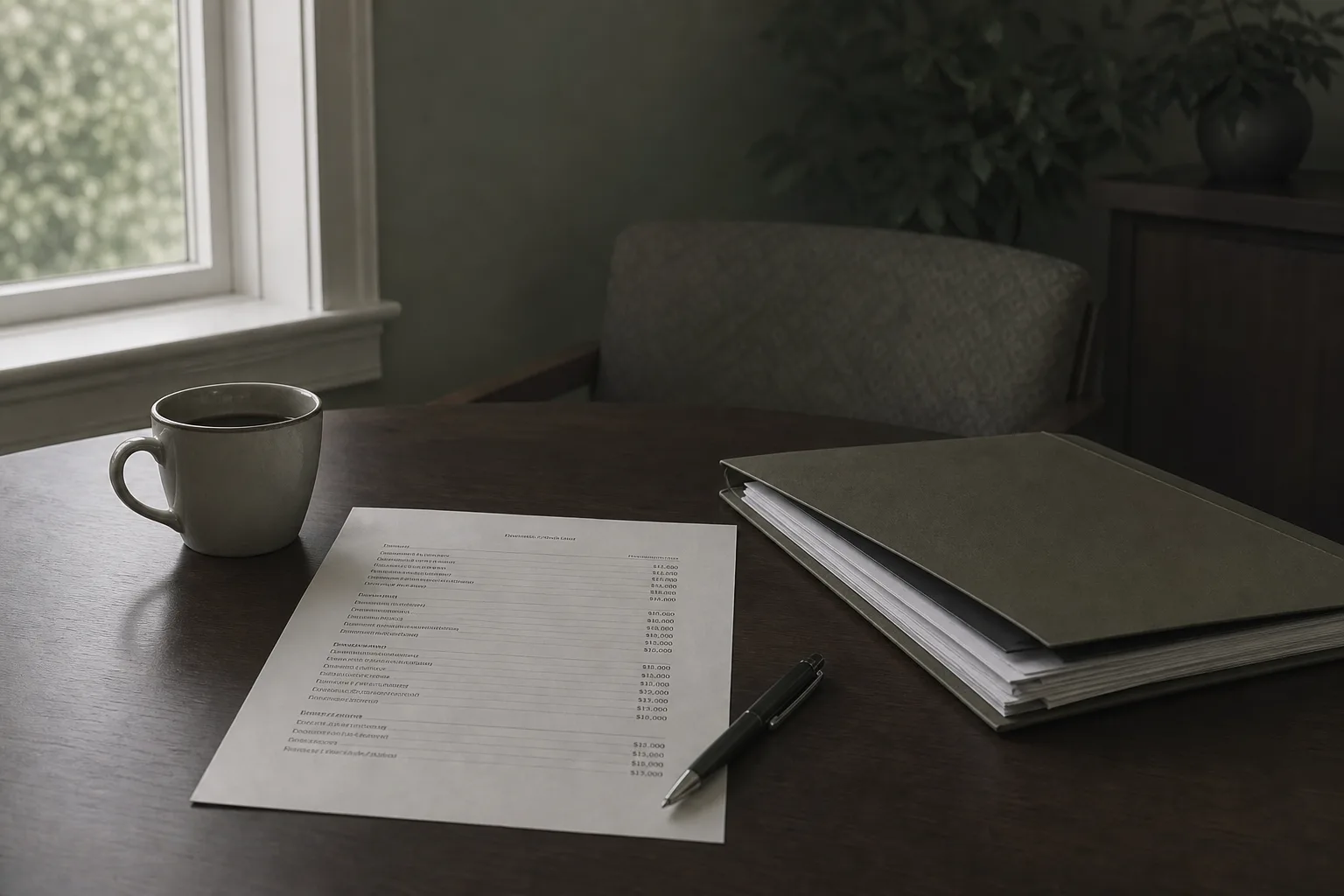
A funeral bill is not a price. It is a stack of separate decisions, presented in a single column, at a moment when almost nobody is reading carefully. Some of those lines are fixed by law or by the cemetery's own rulebook. Most are not. The gap between a family that knows which is which and a family that does not is usually measured in thousands of dollars, and it is decided in the first two days.
The Federal Trade Commission oversees how funeral providers disclose prices, through what the industry calls the Funeral Rule. The practical effect for a consumer is that a provider is expected to give you an itemized price list, to let you buy items separately rather than only as a package, and to quote prices over the phone if you ask. That framework has been in place for decades. What has changed in the last ten years is not the rule so much as the shape of what is being priced.
The one charge that is not optional, and why it appears twice
Nearly every itemized list carries a basic services fee, sometimes labeled the non-declinable fee. It covers the provider's overhead: securing permits, filing the death certificate, coordinating with the cemetery or crematory, staff availability, and the general administration of the arrangement. You cannot decline it, and it is typically the single largest fixed number on the sheet.
It is also the number that gets double-counted. If you select a package, the basic services fee is usually inside it. If you then read a separate line for coordination or documentation, ask whether that is additional or already included. Providers vary in how they present this, and the answer is not always obvious from the layout.
Everything downstream of that fee is a choice. Transfer of remains, use of facilities for a viewing, use of facilities for a service, a hearse, a lead car, printed materials, register books, obituary placement, flowers, and the merchandise itself: casket, urn, outer burial container. Each of those is separately priced because it is separately declinable.
What a decade changed on the sheet itself
Ten years ago, a family walking into an arrangement conference was usually shown a burial-first menu, with cremation presented as a lower-cost alternative near the back. That order has largely reversed in much of the country. Cremation is now the default assumption in many markets, and the pricing has reorganized around it. Direct cremation, with no viewing and no service at the funeral home, is often listed as its own line rather than as a subtraction from something else.
The second change is disclosure practice. A decade ago, obtaining a price list generally meant visiting in person or asking for one to be mailed. Now many providers publish the list on their own website, and comparing three homes in the same county is an evening's work rather than a week's. Practice is uneven, and a posted list is not always the current list, so it is still worth asking for the dated version before you sign.
Third, third-party merchandise has become ordinary. A provider is expected to accept a casket or urn you purchased elsewhere and cannot charge a handling fee for doing so. Ten years ago that conversation was often awkward. Now it is routine enough that many staff will tell you the delivery window without being pushed.
Fourth, the menu of dispositions has widened. Alkaline hydrolysis, sometimes marketed as water cremation, and natural organic reduction, sometimes marketed as human composting, are now authorized in a growing number of states. Availability is state by state and, in practice, facility by facility. Green burial grounds, which prohibit embalming and vaults, have expanded from a handful of sites to a recognized category with published standards.
Where the state and the cemetery decide, not the funeral home
Several charges that feel like upsells are in fact local requirements, and several that feel mandatory are not.
Embalming is the clearest example. No state requires embalming in every case. What states do regulate is what must happen if final disposition is delayed, and the alternative is usually refrigeration. Some states set a window measured in hours; others measure in days; some allow refrigeration indefinitely. A provider that refuses to hold a body unembalmed for a public viewing may be following its own policy rather than a statute, and that distinction is worth asking about directly.
Cremation waiting periods are set by state law and vary. Many states impose a minimum interval between death and cremation, and most require sign-off from a medical examiner or coroner before a crematory will proceed. That clearance, not the funeral home, is usually what sets your earliest possible date.
Outer burial containers, the concrete or metal vaults placed around a casket, are almost never required by law. They are frequently required by the cemetery, for grounds maintenance reasons. The rule lives in the cemetery's own regulations, which also typically govern monument size, marker material, plantings, and whether a second interment is permitted in the same plot. Two cemeteries three miles apart routinely reach different answers.
Whether a family may act without a licensed funeral director at all is also a state question. Most states permit it. A minority require a funeral director to file the death certificate, obtain the disposition permit, or transport remains across county or state lines.
The dates that quietly remove options
Paperwork deadlines are where choices disappear. Death certificate filing windows are set by state statute and are short, commonly a matter of days rather than weeks, and the burial or cremation permit generally cannot issue until the certificate is filed and the certifying physician has signed. A physician traveling for a week can move a service date by a week.
Two other clocks matter. If the death may qualify for a veterans burial allowance or a Social Security lump-sum death payment, each program has its own filing window, and the documentation you need is easier to gather in week one than in month six. And if you are ordering certified copies of the death certificate, order more than you think you need at the outset; the per-copy price at the time of registration is typically lower than a later request to the vital records office, and banks, insurers, and title companies each want an original.
Ask for the dated itemized list, ask which lines the cemetery requires in writing, and ask what the earliest permitted disposition date is given the permit clock. Three questions, asked in the first conversation, settle most of the bill.