FileHealth
One Hospital Bill, Two Phone Calls. Which One You Make First Changes the Outcome
A summary statement and an itemized bill answer different questions, and calling the insurer before the billing office (or the reverse) decides which errors you can actually fix.
- ByRosalind Ntuli
- Cut11/6/25
- Length1,271 words
- Read5 min
A charge you never questioned has a way of surfacing later. It shows up as a deductible that appears to have been met in the wrong plan year, a preventive visit that was billed as diagnostic and therefore cost-shared, a flexible spending account reimbursement that gets clawed back for lack of substantiation, or a $180 balance that turns up on a credit report eighteen months after the appointment. Each of those started as a line on a statement somebody glanced at and paid. The line-by-line read is not an accounting exercise. It is the only point at which most of these are cheap to correct.
Two routes exist for a household that suspects something is wrong. Neither is universally better. They fail in different places, and knowing which one your particular problem belongs to saves weeks.
The summary statement and the itemized bill answer different questions
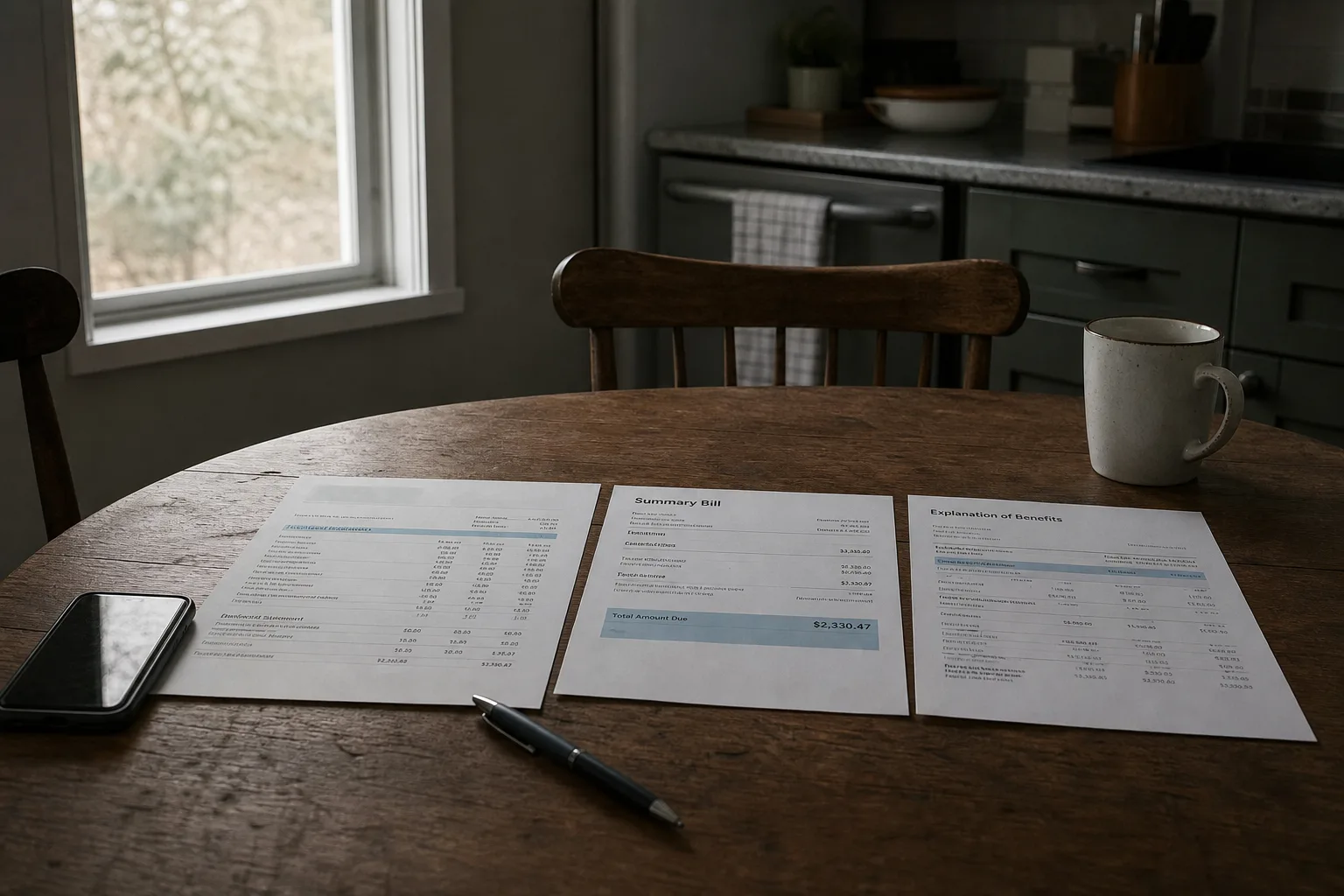
What arrives in the mail from a clinic or hospital is usually a summary. It shows a total charge, an insurance adjustment, a payment, and a patient balance. Sometimes it groups everything under a heading like "Laboratory" or "Emergency Services." It is a demand for money, not an account of what happened.
The itemized bill is a different document and typically has to be requested by name. It lists each service with a procedure code, a date, a quantity, and a unit charge. On a hospital account it will also carry revenue codes, which describe the department that generated the charge. The distinction matters because most billing errors are invisible on a summary and obvious on an itemization: a quantity of two where one item was used, a service dated the day after discharge, a room charge for a night spent in observation, a supply billed separately that the facility fee already covered.
The comparison is not really summary versus itemized. It is whether the amount in dispute justifies the request. If the balance is small and matches what you expected, the summary is enough. Once the balance surprises you, or once the visit involved more than one department, the summary cannot resolve the question and no amount of arguing about the total will make it do so. Ask for the itemized statement in writing and keep the date of the request.
The third document
If you have coverage, there is a third page and it is not a bill: the explanation of benefits from your insurer. It states the allowed amount, what the plan paid, and what was applied to your deductible, coinsurance, or copay. Reading the itemized bill without the explanation of benefits next to it produces a common and expensive mistake, which is disputing a charge that the plan already discounted or paid. Line up the dates of service between the two before you dial anyone.
Calling the billing office first, or calling the insurer first
Both are defensible. They win under different conditions.
Call the provider's billing office first when the problem is arithmetic or description. A duplicate line. A service you did not receive. A quantity that does not match. A date that falls outside the visit. Two accounts for one encounter, which happens routinely when a hospital bills the facility charge and a contracted group bills the professional charge. A payment you made at the front desk that was never posted. These are the provider's records to correct, and the insurer has no standing to change them. Going to the insurer first with a keying error simply adds a month.
Call the insurer first when the problem is coverage. The claim was processed as out-of-network and you believe the provider is in network. A preventive service was cost-shared. A prior authorization was on file and the claim denied for lack of one. The deductible balance on the explanation of benefits does not match your own running total. These are plan-design and adjudication questions, and the billing office will usually, and honestly, tell you the balance is whatever the insurer left behind.
The hard cases sit between the two, and the tell is the denial reason on the explanation of benefits. A denial for a coding or medical-necessity reason is a provider matter, because the fix is a corrected claim submitted by the provider. A denial for eligibility, benefit limits, or network status is an insurer matter. When the two blame each other, ask each one for the specific code or contract term it is relying on, and write down who said what and when. A three-way call is slower to arrange and faster to conclude.
Paying under protest, or holding the balance while it is contested
This is the choice with the longest tail, and households tend to make it by temperament rather than by analysis.
Paying and then seeking a refund protects you from collections activity and from a late-payment posture with a provider you may need again. It works well when the amount is modest, when the error is documented and the provider has acknowledged it, and when the practice has a functioning refund process. The cost is leverage. Money already paid moves back slowly, and a refund request has none of the urgency a balance does.
Holding the balance keeps pressure where it belongs but requires you to run a paper trail. Put the dispute in writing, keep the date, ask for the account to be flagged as under review rather than simply unpaid, and ask what the practice's timeline is for placing accounts with a collection agency. The Consumer Financial Protection Bureau oversees consumer debt collection and credit reporting practices, and the rules governing what a furnisher must do with a disputed account are the reason a written dispute is worth more than four phone calls. Holding wins when the amount is large, when the itemization clearly supports you, and when you have the discipline to follow up on a schedule.
Either way, ask about financial assistance before the account leaves the provider. Nonprofit hospitals maintain written policies, application windows are finite, and eligibility is generally assessed against household income rather than against the balance.
Where the household consequences actually land
Trace the line item forward and it touches more than the checkbook.
- Deductible and out-of-pocket accounting. A claim reprocessed in a later plan year credits the later year. For a family that hit its out-of-pocket maximum in November, a correction in February can quietly undo the benefit of having hit it at all.
- Tax and account substantiation. Health savings and flexible spending account reimbursements are supported by the itemized statement, not the summary. So is any medical expense claimed on a return. The IRS is responsible for the rules on deductible medical expenses, and the recordkeeping standard it applies is service-level, which is exactly what an itemization provides.
- Future coverage decisions. Codes on a claim can influence how a later, related claim is adjudicated. A visit miscoded as diagnostic once may reset the clock on a preventive benefit.
- Credit and lending. A small balance that reaches collections can complicate a mortgage application years later, long after anyone remembers the appointment.
None of this requires fluency in medical coding. It requires the itemized bill, the explanation of benefits, and a decision about which of the two numbers you are actually disputing.
Set a rule for the household and apply it without deliberating each time: request the itemization above a threshold you pick, read it against the explanation of benefits within a week of arrival, and route the question by the denial reason rather than by whichever number is easier to find. The bills that get corrected are almost always the ones that got opened early.