FileHousing
Handed a Roof Report With Nobody There to Explain It? How to Read It Yourself
Roof surveys turned into photo-heavy PDFs for reasons that have little to do with roofs. Here is how to separate observation from recommendation, and which dates actually bind.
- BySylvia Achterberg
- Cut9/25/26
- Length1,333 words
- Read6 min
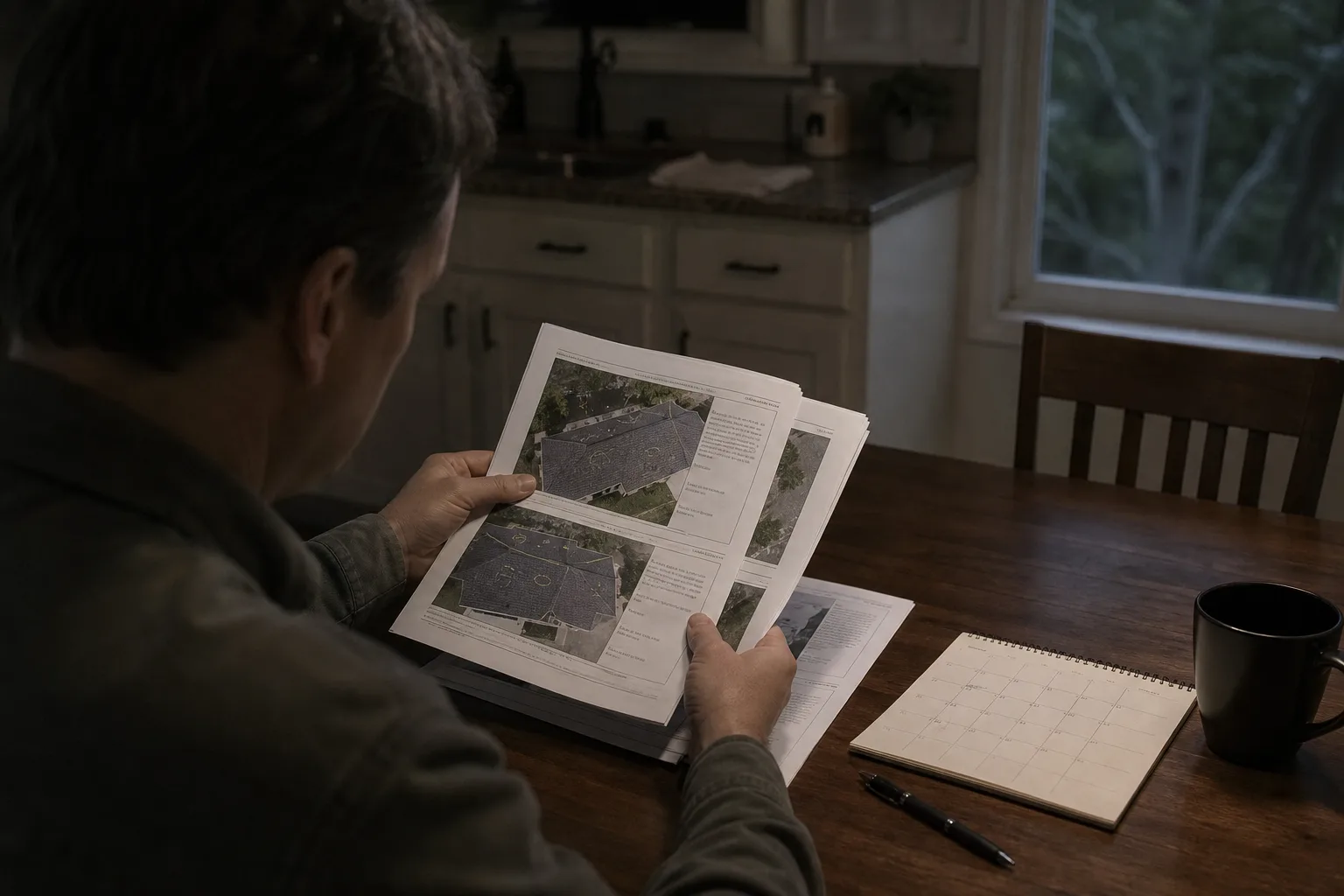
The report arrives as an email attachment on a Tuesday, usually in the evening, usually after the inspector has already driven to the next address. Eighteen pages. Forty photographs. A summary table with colored rows. Somewhere in there is the answer to a question you can phrase in one sentence: does this roof need work this year, and how much. Finding that answer without the person who wrote the document sitting across from you is a specific skill, and it is mostly a matter of knowing which sentences are load-bearing and which are boilerplate.
Why the document looks the way it does
Roof assessments were, for a long time, a conversation on a driveway. A roofer climbed up, came down, told you what he saw, and wrote a number on a pad. What changed that was not roofing. It was documentation pressure from three directions at once.
Real estate transactions came first. Once a roof condition could become a renegotiation item or a disclosure dispute, the written record stopped being optional, and inspectors began writing for a reader who might be an attorney rather than a homeowner. Insurance followed. Carriers began asking for dated, photographed evidence of roof condition at underwriting and again at claim, which pushed the industry toward reports that time-stamp what was visible on a particular day. Manufacturer warranties added the third layer: many material warranties are conditioned on documented installation and periodic inspection, so the report started doubling as a compliance record.
Then cameras got cheap and drones got legal. A survey that once consisted of three blurry photos now routinely includes overhead imagery of every slope, close-ups of each penetration, and attic shots if access existed. The practical effect for a homeowner reading alone is that the modern report contains far more evidence and, oddly, often less interpretation. The inspector documents. You are expected to decide.
Three kinds of sentences, and only one of them is a fact
Every roof survey mixes observation, inference, and recommendation, usually without labeling which is which. Sort them before you do anything else.
Observation describes what the camera or the hand found. "Granule loss visible on south slope field shingles." "Sealant at the rear pipe boot is cracked through." "Ponding at northeast corner of low-slope section, approximately two feet across." These are checkable. If you go outside with the photo, you can find the thing.
Inference draws a conclusion from the observation. "Consistent with a roof at or near the end of its serviceable life." "Suggests prior repair rather than original installation." Inference is where experience lives, and also where reasonable inspectors disagree. It is not wrong, but it is an opinion with a photograph attached.
Recommendation proposes action and, if the inspector also sells roofing, carries a commercial interest. That is not a scandal; it is the structure of the trade. It does mean you read recommendations against the observations rather than in place of them. If the report recommends full replacement, go back and count how many observations are actually defects and how many are notes about age.
A useful test on your own: for each recommended line item, find the observation that supports it. Items that recommend work without a supporting observation are the ones to ask about.
What the report says it did not look at
The limitations paragraph is the part people skip and the part that changes what you are holding. Look for phrases like "viewed from ladder at eave," "evaluated by aerial imagery only," "attic access not available," or "portions obscured by solar array."
Access limits are often not laziness. The Occupational Safety and Health Administration is responsible for fall protection standards in the construction trades, and firms that follow them will not send someone onto a steep or deteriorated slope without anchorage, which is why so many reports now lean on drone imagery for the upper field. Aerial photography is excellent for identifying missing shingles, displaced flashing, and debris patterns. It is poor at telling you whether a deck is soft underfoot or whether a nail line was set too high. If the survey never had someone standing on the roof, the report cannot speak to decking, and an honest one will say so.
Note also what was excluded on purpose. Gutters, skylight glass, chimney masonry above the flashing, and interior ceiling staining are commonly outside scope. A clean roof report does not mean a clean building envelope.
The dates inside it, and which ones start a clock
This is where reading alone genuinely costs people money, because the report contains several dates that look alike and do entirely different things.
- Date of inspection. Describes the roof on that day and no other. If a storm passed through afterward, the report is history, not a current condition. Carriers and buyers both treat staleness differently; a survey more than a few months old will often be asked for again.
- Proposal or estimate validity. Frequently thirty days, sometimes less when material pricing is volatile. When it lapses, the number is not a number anymore. Nothing terrible happens, but you lose the ability to say you were quoted that figure.
- Transaction contingency deadlines. If the survey was ordered during a purchase, the inspection or repair request window is set by the contract, not by the inspector, and it is usually measured in days from acceptance. Miss it and the right to raise the roof as an issue is typically gone, regardless of what the report found.
- Insurance notice requirements. Policies generally require prompt notice of damage. A report that documents storm-related damage may be the trigger for that notice. Sitting on it for two months while you gather bids is exactly the sequence carriers point to when they question the timeline.
- Permit validity. Where a permit is required, it expires if work does not start within the issuing jurisdiction's window, and reinstating it usually means paying again.
Write these five dates on the first page in pen. That single step converts an eighteen-page PDF into a calendar.
The ordinary week this actually occupies
Read on Tuesday night, skim the summary, read the limitations paragraph, and stop. Do not make a decision that night. Wednesday, take the photos outside in daylight and match four or five of them to the actual roof from the ground. You are not auditing the inspector. You are building enough familiarity to ask a specific question instead of a general one.
Thursday, send the questions in writing. Three or four, numbered, each tied to a photo number or a line item. Written questions produce written answers, and written answers are what you still have in six months. Ask whether anyone walked the roof. Ask which items are safety or leak issues and which are wear. Ask what happens if a given item waits twelve months.
The following week is comparison. Two firms advertising roof repair in long beach may both use a three-tier condition scale and mean different things by the middle tier, so compare the observations and the scope lines rather than the grades or the totals. Coastal exposure sharpens this: salt air, marine layer moisture, and wind-driven rain on west and south elevations tend to age flashing, fasteners, and sealant faster than field material, which is why a report from a nearby crew will often flag metal details the aerial-only version treats as incidental.
Second opinions are normal and cost little. What matters is giving the second inspector the same access the first one had, and not showing them the first report until after they have written theirs.
A roof survey read properly gives you three things: a short list of items that cannot wait, a longer list that can be scheduled, and a set of dates that decide which options stay open. Everything else in the file is evidence supporting those three. Once you have sorted them, the conversation with a contractor becomes a short one about scope and sequence, which is the conversation you wanted in the first place.