FileFinance
A Shoebox Full of Faded Paper: Why the Receipt Problem Is Solved at the Register
Records fail at the moment of the transaction rather than at the moment of filing, which is why sorting systems keep collapsing and capture habits do not.
- ByRosalind Ntuli
- Cut4/8/26
- Length870 words
- Read4 min
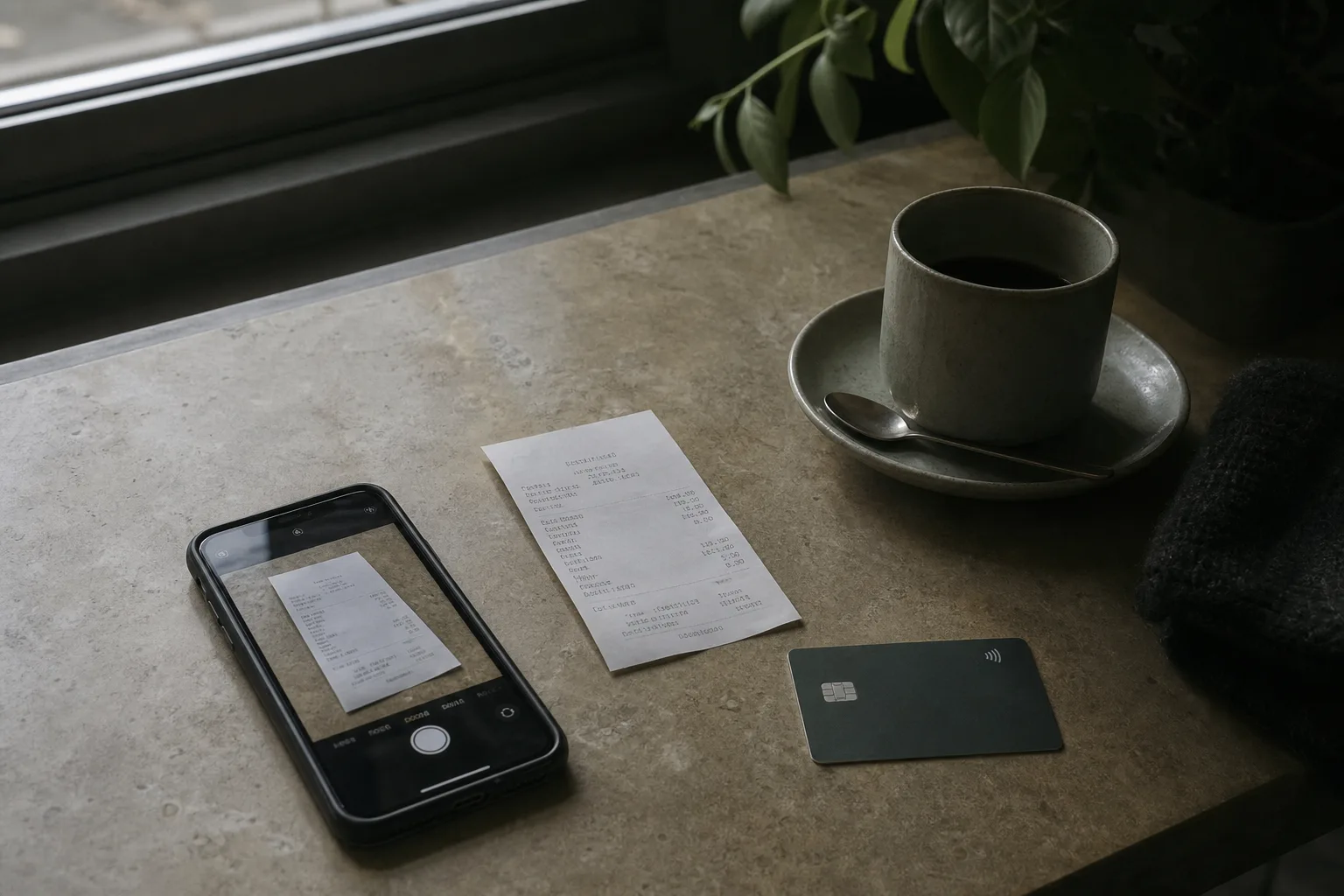
Picture the shoebox on the shelf in April, holding a year of curled paper and a few register slips that have faded to blank. It looks like a filing failure and it is not. It is a capture failure that only becomes visible at filing time, months after the moment when fixing it would have been free. A receipt photographed in the parking lot needs no sorting later. A receipt that went into a pocket needs a decision, a category and a memory of what it was for, all supplied in spring by somebody who has none of the three.
Why Sorting Later Always Loses
Three things decay in the months between a purchase and a filing, and only one of them is the paper. The business purpose is obvious at the time and genuinely gone by spring. That is why so much of the work in March consists of staring at a card statement trying to reconstruct why a hardware store took forty dollars in August. The category goes with it, since ambiguous purchases can only be sorted by guessing once the context has faded. And thermal register paper commonly fades to unreadable inside a year in a warm car or a wallet.
A record that satisfies a tax authority has to show what was bought, when, from whom, for how much, and why it counted as a business expense. Only the last depends on memory, and a two second note at the counter preserves it permanently. Everything that works here works for one reason: it moves the effort to the moment of the transaction, when the information is free. Everything that fails defers that effort to a person who will not have the information.
Three Capture Methods That Actually Hold
The first is photograph and forget. Take a picture of every business receipt before leaving the counter, write the purpose into the file name or the note field, and once a month move the images into that month folder. It suits a business with a modest number of transactions and no appetite for software. It produces records that will still be legible in five years, which is more than can be said for the originals. The whole habit costs perhaps four seconds per purchase and requires no decision at all beyond taking the photograph.
The second is a dedicated account with a clean feed, meaning every business transaction runs through one card and nothing personal goes near it. The statement then becomes the ledger and receipts exist to support entries rather than to create them, which is the highest value change available to a small operator and costs nothing. The third is bookkeeping software with a capture app, where the photograph attaches to the transaction automatically and the category is assigned once and remembered, worth the subscription above a few dozen transactions a month.
What Still Has to Exist as a Document
A few categories are not satisfied by a receipt image, and they are reliably the ones missing when somebody looks. Mileage needs a contemporaneous log carrying date, destination, purpose and miles, because a photograph of a gas receipt proves that fuel was bought and says nothing about whether the trip was for business. Meals need the receipt plus who was present and what was discussed, noted at the time rather than recalled. Anything durable needs its invoice kept for as long as the item is owned and for the years afterward during which a sale could be examined.
How Long to Keep It
Retention causes more anxiety than it needs to, and the shape of the answer is stable even where specifics vary. Ordinary supporting records for a filed return are generally kept for several years from filing, because that is the window in which a return can be examined, which is the framing the Internal Revenue Service uses rather than an accountant rule of thumb. Records supporting a position that stays open longer are kept longer, and seven years works as a default for general small business records.
Three categories run past that entirely. Asset records are kept for as long as the asset is owned plus the examination period after it is sold, because basis is a question that only ever arises at disposal. Employment tax records carry their own requirement. And anything establishing the cost of a home improvement should be kept until the home is sold and that sale is beyond review, which for a long tenure means decades. Digital storage is now cheap enough that the practical household rule is to keep images indefinitely and discard only paper.
Where to Stop and Hand It Over
Capture belongs to the owner and cannot be delegated, because it happens at the register and no bookkeeper can reconstruct a business purpose they were not present for. Classification and reconciliation are the natural handoff, and a bookkeeper working from a clean feed and captured images is fast and inexpensive while the same bookkeeper working from a shoebox is neither. The economics of that handoff are decided entirely by the quality of what arrives. That is why the habit is worth building first and the help worth hiring second, and why April stops being a project.