FileFamily
Upright or Flush, Granite or Bronze. How Local Rules Narrow the Memorial Before You Pick
Two defensible memorial choices, the conditions under which each one wins, and the handful of decisions that cannot be revised once the order is cut.
- ByRosalind Ntuli
- Cut2/4/26
- Length1,234 words
- Read5 min
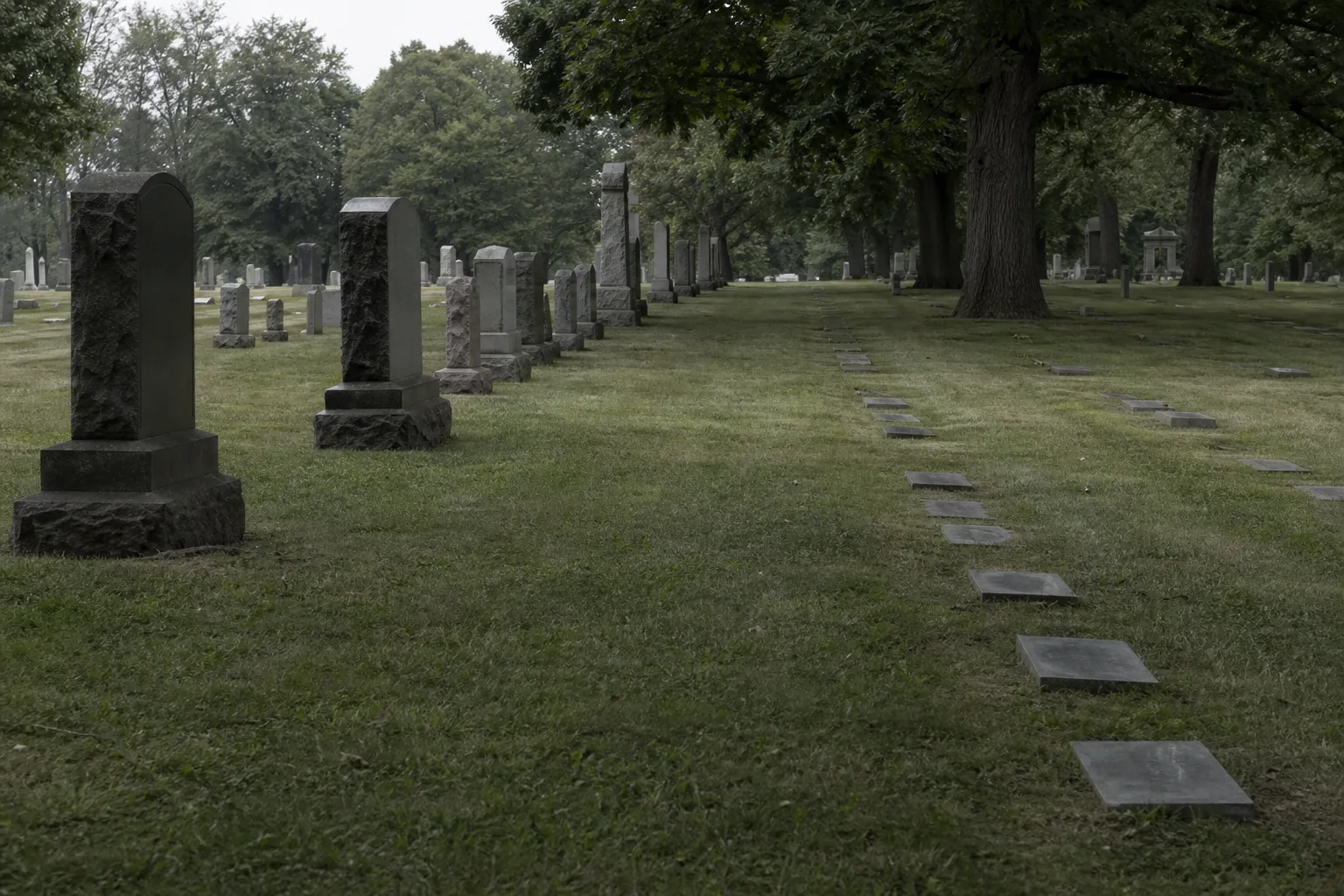
Most families choosing a memorial are working from a catalog and a price. That is the wrong starting document. The order of operations that produces a decision people are still satisfied with in twenty years runs the other way: find out what the cemetery, the state, and the climate will allow, then choose between the two or three options that survive, then look at the catalog. Regional rules do a great deal of the narrowing for you, and they do it before anyone has quoted a dollar figure.
What follows is a way to build the judgement rather than a recommendation. In each pair below, both options are defensible. What decides between them is local.
Upright monument or flush marker, and what actually decides it
An upright monument (a die on a base, standing above grade) and a flush marker (a flat granite or bronze tablet set level with the lawn) are both permanent, both conventional, and both available in most of the country. The choice is usually made for the family by three things.
The first is the section. Many cemeteries divide their grounds into monument sections and lawn-level sections, and the rule is absolute within each one. A family that bought spaces in a memorial-park section in 1994 does not get to install an upright in 2026 because they now prefer one. Before anything else, ask which section the deed covers and what heights and footprint that section permits. Get the answer in writing, with the height limit and the maximum base dimensions stated as numbers.
The second is maintenance practice, which varies more by region than most families expect. Grounds crews that mow with wide-deck equipment tend to favor flush markers, and the rules follow the equipment. Older municipal and church cemeteries in the Northeast and Midwest, mowed and trimmed by hand for a century, often still permit uprights of substantial size. In much of the Sun Belt, cemeteries developed after the 1950s were laid out as memorial parks from the start, and flush is the only option on offer.
The third is frost. In states with a meaningful freeze-thaw cycle, an upright monument needs a foundation that reaches below the frost line, and the cemetery normally sets both the depth and the installer. Where that requirement exists, it moves an upright from a marker decision to a small construction project with its own charge and its own seasonal window. Flush markers sit on a shallower setting bed and are less exposed to heave.
The upright wins where the section allows it, where visitation is frequent and the family wants something findable and readable from a distance, and where the marker is expected to carry several names over decades. The flush marker wins where the section requires it, where the surrounding rows are already level and an upright would look imposed, and where the family wants the lowest exposure to settling, mower damage, and eventual resetting fees.
Granite or bronze, decided by the weather and by who replaces it
The second pair is material. Granite and bronze-on-granite are both standard, and the honest comparison turns on climate and on repair economics rather than on appearance.
Granite handles freeze-thaw, ultraviolet exposure, and acidic rain with very little change. Lettering methods matter more than the stone: sandblasted lettering cut deep enough holds legibility far longer than shallow etched or laser work, particularly on dark stone in a wet climate where lichen fills the letter. In arid regions, wind-driven dust polishes exposed surfaces over decades, which argues for deeper cuts and simpler lettering. Colors quarried locally are usually cheaper and easier to match if a companion piece is added later, which is a real consideration for a family plot that will be added to.
Bronze reads crisply, resists cracking, and is standard equipment in many memorial-park sections. Its weakness is coastal. Salt air accelerates corrosion, and a bronze tablet within a few miles of the ocean needs periodic cleaning and waxing that someone has to actually perform. In some cemeteries that work is covered by the endowment care fund; in others it is the family's problem, and nobody says so at the time of sale. Bronze is also the more attractive target for theft in some areas, and a handful of states have written scrap-metal statutes that make cemetery bronze harder to sell.
Bronze wins inside sections that require it, in inland climates, and where the family values crisp typography and a low profile. Granite wins near salt water, in freeze-thaw states, and anywhere the family expects to add names later and wants a material and color they can match.
Where the rule is state law and where it is house policy
Learning to tell these apart is most of the skill. The Federal Trade Commission is responsible for the Funeral Rule, which governs how funeral providers disclose prices and what they may require a family to buy. Its reach over cemeteries and monument dealers is narrower than families assume, which is why so much of what you will be told is house policy rather than law.
State law tends to cover the cemetery's endowment or permanent care fund, licensing of sellers, and cancellation rights on pre-need contracts. Those cancellation windows differ substantially from state to state, and they are the reason to read a pre-need cemetery agreement before signing rather than after. Some states regulate whether a cemetery may require that memorials be purchased from the cemetery itself; where a right to buy elsewhere exists, cemeteries typically retain the right to charge a setting or inspection fee and to specify foundation work.
Then there are the local layers. Historic and municipal cemeteries may sit inside a local preservation ordinance that limits materials and finishes. Veterans buried in a national cemetery receive a government-furnished marker in a fixed style with a fixed inscription format, which removes most of the choice and most of the risk at once. In an older section with active plot-owner associations, the rules can be stricter than anything the state requires. Ask which body wrote each rule you are given, and ask for the page.
The decisions that cannot be revised
Some of this is correctable. Cleaning schedules, vase and flower rules, and even a resetting after settlement are all ordinary maintenance. A short list is not.
- Inscription text and spelling. Once it is cut, correction means a new stone. Proof the layout on paper, in the actual line breaks, and have a second family member sign it.
- Section and grave selection. The section carries the memorial rules with it. Transfers and refunds on interment rights are governed by the cemetery's own contract and by state law, and are rarely full.
- Foundation size. A foundation poured for a given base limits what can replace the stone later. Oversizing it slightly costs little at the time and nothing afterward.
- Pre-carved names and dates. Adding a living spouse's name is common and sensible. It also fixes the design, the stone color, and the lettering style for whatever happens next.
The families who come out of this well are not the ones who spent the most. They are the ones who asked for the section rules in writing, read the pre-need contract before the arrangement conference, walked the section to see how thirty-year-old markers in that exact soil and weather have held up, and then priced a single agreed specification with two dealers.